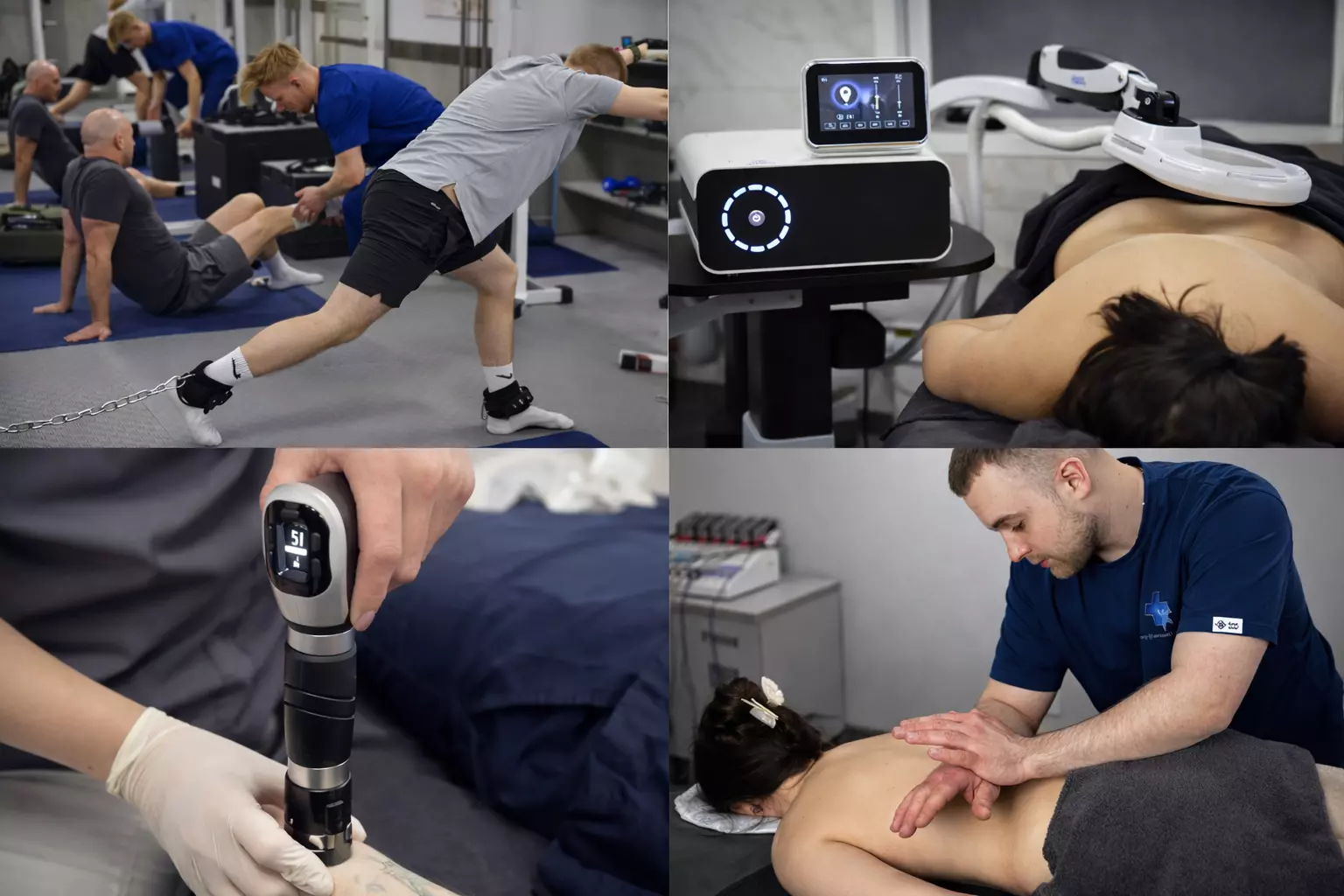
After removing or treating a Baker's cyst, it is important not to simply wait for the knee to "work itself out," but to gradually restore motion, strength, gait, and swelling control.
The specialist analyzes the discharge, postoperative recommendations, pain, swelling, scar condition, knee mobility, muscle strength, and gait quality. Symptoms that may require additional medical examination are also evaluated: calf pain, redness, temperature, or a sharp increase in swelling.
At the initial stage, the program is aimed at gently reducing tissue reaction. The load is selected so as not to provoke repeated swelling and not to increase tension in the popliteal area.
The exercises help gradually restore range of motion, activate the quadriceps, hamstrings, calves, and knee stabilizers. The movements are simple and controlled at first, then strength, balance, and functional tasks are added.
After pain or surgery, the patient often begins to protect the leg, which causes lameness. Gait work helps restore a symmetrical step, normal support, and confidence during movement.
If there is severe calf pain, increasing swelling, redness, fever, discharge from the wound, or a sudden worsening of the condition, the activity should be postponed and a doctor should be consulted. Such symptoms may require a medical evaluation before rehabilitation.
Gradually, stiffness decreases, knee flexion improves, muscle strength returns, and gait normalizes. The patient better understands what load the knee can withstand without swelling and how to safely return to activity.
Sign up for an assessment at KINEZIUM and start your knee rehabilitation after Baker's cyst with an individual program.
wellness centers
patients were helped
specialists
years of experience

Leave your contacts — our specialist will contact you within 10–15 minutes to help you choose a service and answer all your questions.
Rehabilitation after Baker's cyst removal at KINEZIUM includes pain control, swelling, knee mobility, thigh and calf muscle strength, and gradual gait restoration. If the cyst was treated with puncture, surgery, or conservatively, it is important to consider the cause of fluid accumulation in the knee area. Often, the work is aimed not only at the back of the knee, but also at the entire joint: flexion, extension, stability, and load tolerance. The program may include exercise therapy, gait training, physiotherapy as indicated, swelling control, and home recommendations.
The program may be needed by patients after removal, puncture or treatment of a Baker's cyst if there is still discomfort behind the knee, swelling, stiffness or limitation of gait. Sometimes a person feels tension in the popliteal area, difficulty bending the knee, discomfort when climbing stairs or sitting for a long time. If symptoms recur, it is important to evaluate the condition of the knee joint, not just the cyst itself.
Situation | What the program helps to assess |
After cyst removal | Scar, swelling, knee range of motion, gait, and strength |
After puncture | Tissue response, load control and risk of re-edema |
Discomfort behind the knee | Posterior knee tension and flexion limitation |
Knee stiffness | Range of motion and safe exercises |
Gait disturbance | Step symmetry, resistance and muscle strength |
Swelling after exercise | The need for intensity correction and doctor's consultation |
Evaluations should include pain behind the knee, swelling, tightness, limited flexion, calf pain, redness, or a sudden worsening of the condition. It is especially important not to ignore calf pain, calf swelling, skin discoloration, or a feeling of warmth, as some symptoms may resemble vascular complications. If there is fever, wound discharge, increasing pain, or redness after surgery, a doctor should be consulted. Rehabilitation should be initiated after checking for such risks.
Knee rehabilitation after a Baker's cyst helps restore range of motion, strength of the thigh and calf muscles, stability, gait, and load tolerance. If the patient begins to protect the leg after pain or surgery, lameness, weakness, and fear of bending the knee may occur. The program gradually restores control of movement: first gentle range and muscle activation, then strength, balance, stairs, and functional loads. It is important not to force bending due to severe pain or swelling.
The initial assessment after Baker's cyst removal begins with an analysis of discharge, pain, swelling, knee mobility, strength, gait, postoperative limitations and contraindications. The specialist clarifies when the intervention was performed, whether there are stitches or a scar, whether weight bearing is allowed, how the knee responds to walking and bending. The calf, lower leg swelling, temperature, redness and other signs that may require medical evaluation are separately assessed. After this, a safe amount of exercise and the pace of return to activity are determined.
Rehabilitation after a Baker's cyst focuses more on controlling swelling, the posterior aspect of the knee, range of motion, the cause of the fluid accumulation, and gradual weight bearing. After a knee injury, the emphasis may shift to ligaments, menisci, stability, or post-operative protocol. In real-life practice, these areas may overlap, as the cyst is often associated with internal knee problems.
Criterion | After Baker's cyst | After a knee injury |
Focus | Swelling, posterior knee, flexion | Structural damage, stability, tissue healing |
Symptoms | Tension behind the knee, stiffness, swelling | Post-injury pain, instability, locking, weakness |
Limitation | Postoperative rules, fluid control | Protocol by type of injury or surgery |
Exercises | Amplitude, strength, gait, edema control | Stability, strength, balance, return of function |
Risks | Recurrent swelling, calf pain, signs of infection | Overloading of damaged structures, instability |
A program after a Baker's cyst may include knee, hip, and lower leg exercises, gait training, physiotherapy as indicated, edema control, and home recommendations. Early on, gentle movements, muscle activation, and safe walking without provoking edema are important. Later, quadriceps and gluteal strength exercises, balance, stairs, and a gradual return to daily activities are added. If the cyst is associated with osteoarthritis or an intra-articular problem, the program is adapted to the underlying condition of the knee.
After a Baker's cyst, you should consider acute pain, increased swelling, redness, calf pain, suspected thrombosis, signs of infection, and post-operative restrictions. If the lower leg is swollen, painful, discolored, or hot, you should not continue exercising without medical evaluation. After surgery, it is also important to monitor the condition of the wound, temperature, discharge, and sudden increase in pain.
MedlinePlus, in its recommendations after knee arthroscopy, states that you should contact your surgeon if you experience increasing pain, swelling or pain in your calf, discoloration of your foot or toes, redness, discharge from your incisions, or a temperature above 101°F (38.3°C): https://medlineplus.gov/ency/patientinstructions/000199.htm. MedlinePlus also lists the following warning signs in its article on knee pain: inability to support the knee, severe pain, deformity, locking, inability to bend or straighten the knee, temperature, redness, warmth, significant swelling, or pain in the calf with numbness or discoloration: https://medlineplus.gov/ency/article/003187.htm. The Cleveland Clinic describes that a ruptured Baker's cyst can cause sharp pain in the calf, swelling, and redness, so it's important to distinguish these symptoms from other dangerous conditions: https://my.clevelandclinic.org/health/diseases/15146-bakers-cyst. Therefore, rehabilitation after a cyst must consider not only the knee, but also vascular and postoperative risks.
To sign up for rehabilitation after Baker's cyst at KINEZIUM, you need to prepare a discharge, doctor's recommendations, data on surgery, puncture or previous treatment. When making an appointment, you should inform when the intervention took place, whether there is swelling, pain behind the knee, pain in the calf, limitation of bending or difficulty walking. During the initial assessment, the specialist will check mobility, strength, gait, swelling, contraindications and postoperative limitations. After that, an individual knee recovery program is formed.
Leave your contacts — our specialist will contact you within 10–15 minutes to help you choose a service and answer all your questions.