 Skip to content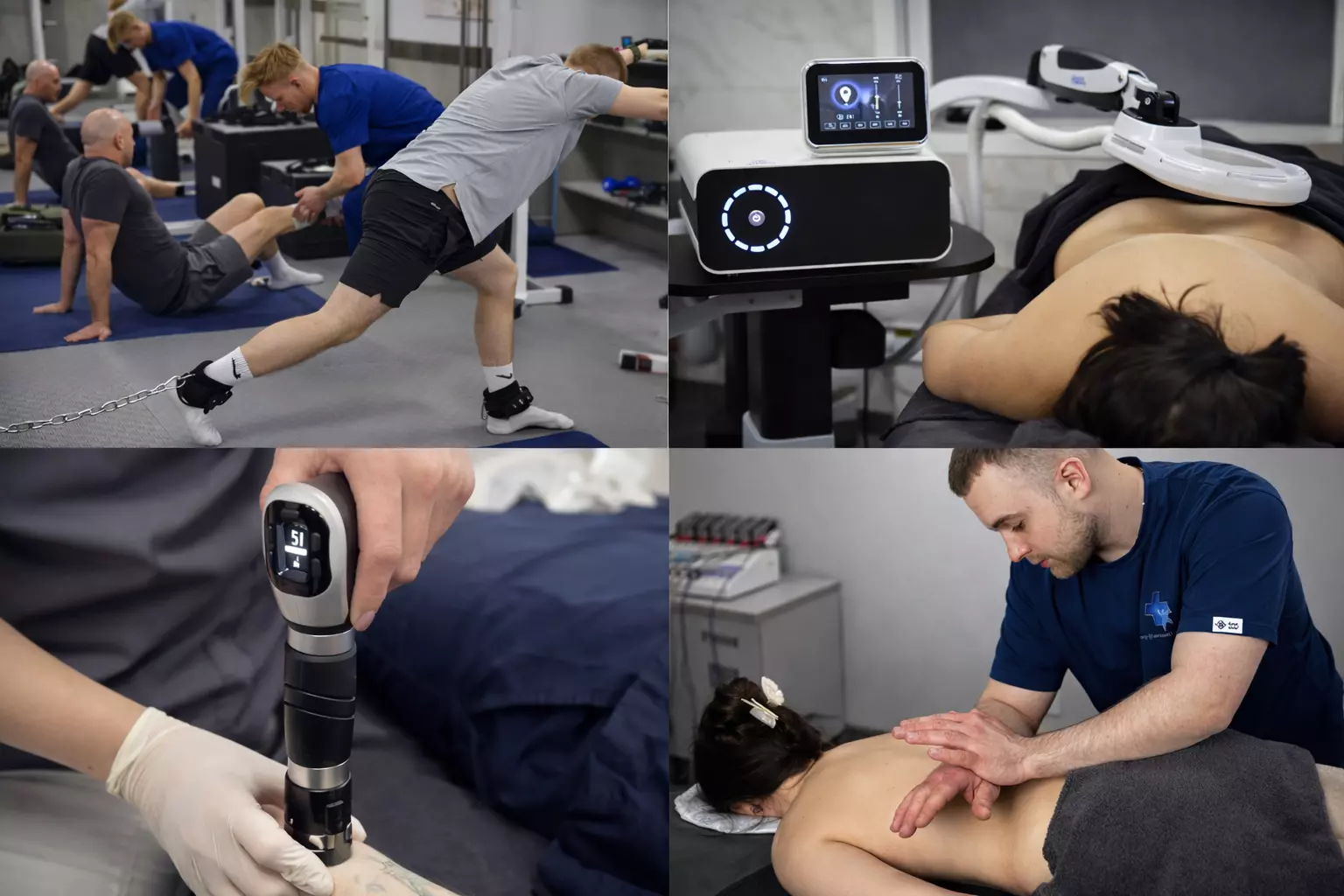
Wellness centers
Patients were helped
Specialists
Years of experience
Physio-procedures — are modern methods of treatment and rehabilitation that use physical factors (current, magnetic field, ultrasound, heat, etc.) to reduce pain, inflammation, and accelerate tissue repair. They are an important component of a comprehensive approach to the treatment of diseases of the musculoskeletal system and nervous system.
back, neck, joint pain
muscle spasms and overstrain
numbness, neurological symptoms
consequences of injuries and operations
inflammatory processes
chronic pain syndromes
active rehabilitation period
Depending on the method of exposure, physiotherapy allows:
reduce pain and swelling
reduce inflammation
improve blood circulation and metabolic processes
accelerate tissue healing
relax muscles and reduce spasm
prepare the body for active rehabilitation
Physiotherapy is selected individually, taking into account the diagnosis and condition of the patient:
Hardware treatment methods — for medical reasons
Combination with exercise therapy, massage and manual correction
Safe and controlled exposure parameters
Course treatment — for a stable result
State dynamics control during the course
💡 The result of physiotherapy procedures — reducing pain, improving mobility, accelerating recovery, and increasing the effectiveness of the entire rehabilitation program.
We are grateful to everyone who has entrusted their health to us.
Your feedback is the best confirmation of the results of our work.
Share your impressions - they inspire us to become even better every day.
Leave your contacts — our specialist will contact you within 10–15 minutes to help you choose a service and answer all your questions.
We are always open for communication and ready to help you.
Call or email us to schedule a consultation or get detailed information.
Our experts will suggest the best solution for you.
Physiotherapy and physiotherapy procedures at KINEZIUM are part of rehabilitation, which are used to work with pain, mobility, joints, muscles and recovery from injuries or overloads. Procedures are not selected only by the name of the diagnosis, because back pain, arthrosis, osteochondrosis or a condition after a fracture may have different limitations. Before starting, the specialist assesses complaints, mobility, strength, pain, swelling, sensitivity, contraindications and the goal of recovery. Physiotherapy can help reduce discomfort and prepare tissues for active work, but often the best result is obtained in combination with exercise therapy, kinesiotherapy or other rehabilitation methods. At KINEZIUM, the procedure should not be random, but part of an individual plan.
Physiotherapy for osteoarthritis or osteochondrosis may be needed by patients with joint pain, back pain, limited movement, muscle tension, discomfort after exertion, or recovery from injuries and fractures. With osteoarthritis, it is important to maintain joint mobility, muscle strength, and load tolerance. With osteochondrosis or spinal pain, it is necessary to consider not only local pain, but also neurological symptoms, posture, work habits, and reaction to movement.
Condition or complaint | When physiotherapy may be appropriate |
Arthrosis of the joints | For support work with pain, mobility and load tolerance |
Osteochondrosis | For pain, stiffness, muscle tension after assessment of neurological symptoms |
Back pain | When you need to reduce discomfort and prepare your body for exercise |
Joint pain | Unless there is acute inflammation, signs of infection, or injury requiring a different route |
After injuries | After stabilization of the condition and taking into account the permissible load |
After fractures | When the doctor has cleared recovery and you need to work on mobility, strength, and function |
Physiotherapy for joints and back can help reduce pain, maintain mobility, improve load tolerance and create conditions for active rehabilitation. If a person avoids movement due to pain, muscles weaken, and the joint or spine begins to tolerate everyday activities worse. In such a situation, physiotherapy can be the first step towards more comfortable exercise. At the same time, it does not replace motor work if you need to restore strength, stability, coordination or gait. Therefore, at KINEZIUM, physiotherapy procedures are often considered as an auxiliary component of comprehensive recovery.
The recovery program may include hardware techniques, physical therapy, rehabilitation classes, exercise therapy, kinesiotherapy, massage, or a combination of several methods as indicated. The specific set of procedures depends on the diagnosis, duration of the problem, pain, swelling, sensitivity, postoperative limitations, and the patient’s goals. For example, back pain may require physiotherapy plus core stabilization exercises, and after a knee injury, swelling control, exercise therapy, gait training, and gradual strength gains. If there is acute pain, fever, suspected infection, or neurological symptoms, some procedures may be postponed. The right program should be flexible and adjusted according to the body’s response.
Physiotherapy at the KINEZIUM center in Kyiv begins with a consultation or initial assessment of the condition. The specialist clarifies the complaints, diagnosis, previous examinations, contraindications, the purpose of the procedure and the expected result. Then the technique, area of impact, duration, intensity and frequency of sessions are selected. During the course, it is important to monitor the reaction: pain, swelling, sensitivity, mobility and general well-being. If the symptoms change, the plan is adjusted - exercises are added, the intensity is changed or a doctor's consultation is recommended.
Physical therapy treatment usually focuses more on procedures and physical factors that help work with pain, tissue, muscle tension, or swelling. Physical rehabilitation is broader: it includes active exercises, restoring strength, coordination, gait, balance, daily activities, and load control. In many cases, these areas do not compete, but complement each other.
Criterion | Physiotherapy treatment | Physical rehabilitation |
Main focus | Procedures, physical factors, pain and tissue management | Movement, strength, coordination, function and return to activity |
Patient participation | Often passive or partially active | Active: exercise, walking, functional tasks |
Target | Reduce symptoms and support recovery | Return a specific function and load |
When appropriate | For pain, swelling, spasm, preparation for exercises | After injuries, surgeries, weakness, limited movement |
Optimal result | Often as part of a comprehensive plan | Usually requires regularity and progression |
Before physiotherapy, it is necessary to take into account acute inflammation, fever, active infection, oncological risks, pacemaker for certain techniques, pregnancy, skin lesions, bleeding, thrombosis risks, sensory disturbances and postoperative limitations. Caution is also required in case of severe pain, severe swelling, numbness, progressive weakness or pain after injury. If symptoms are unexplained or rapidly worsening, physiotherapy should not be started without medical evaluation.
MedlinePlus describes rehabilitation as a process that helps restore abilities after injury, illness, or treatment, but the plan depends on the cause of the problem and the severity of the condition: https://medlineplus.gov/rehabilitation.html. NCBI Bookshelf explains in its article “In brief: Physical therapy” that physical therapy can include exercise, massage, and physical stimulation, but the choice depends on the patient’s condition: https://www.ncbi.nlm.nih.gov/books/NBK561514/. MedlinePlus, in its article on joint pain, advises you to see a doctor if you have severe pain, significant swelling, hot or red skin around the joint, or a fever: https://medlineplus.gov/ency/article/003261.htm. Therefore, before the procedure, it is important to check not only the indications, but also the reasons why the technique may be dangerous.
After physiotherapy treatments at KINEZIUM, you can expect a gradual reduction in discomfort, improved mobility, support for recovery and better load tolerance. The result depends on the diagnosis, the duration of the problem, the number of treatments, the reaction of the tissues and whether physiotherapy is combined with active rehabilitation. If the problem is chronic or associated with weakness, instability or gait disturbance, one treatment may not be enough. That is why the effect is assessed in dynamics: what has become easier to do, how has the pain changed, whether the function has improved.
NCBI Bookshelf, in the material “Therapeutic Exercise”, emphasizes the role of prescribed exercises in restoring musculoskeletal function: https://www.ncbi.nlm.nih.gov/books/NBK555914/. NCBI Bookshelf, in its article “In brief: Physical therapy,” describes physical therapy as a combination of exercise, physical stimulation, and patient education: https://www.ncbi.nlm.nih.gov/books/NBK561514/. The University of Rochester Medical Center describes physical rehabilitation as working on strength, flexibility, range of motion, coordination, balance, and safety: https://www.urmc.rochester.edu/encyclopedia/content?contentid=111&contenttypeid=134. Practical conclusion: Physiotherapy makes the most sense when it is built into a clear recovery plan.
The price of physiotherapy in Kyiv depends on the method, duration of the course, number of procedures, area of impact, complexity of the condition and the need for consultation. A single procedure and a full recovery course can differ significantly in volume. If physiotherapy is combined with exercise therapy, massage, kinesiotherapy or a doctor's consultation, the total cost is formed according to a broader plan. To clarify the price at KINEZIUM, you should describe the complaint, diagnosis, previous examinations and the desired result. After the assessment, the specialist will explain which method is needed, how many procedures may be required and what restrictions to take into account.
Leave your contacts — our specialist will contact you within 10–15 minutes to help you choose a service and answer all your questions.
Leave your contacts - our specialist will contact you within 10-15 minutes to help with the service and answer all your questions.