 Skip to content
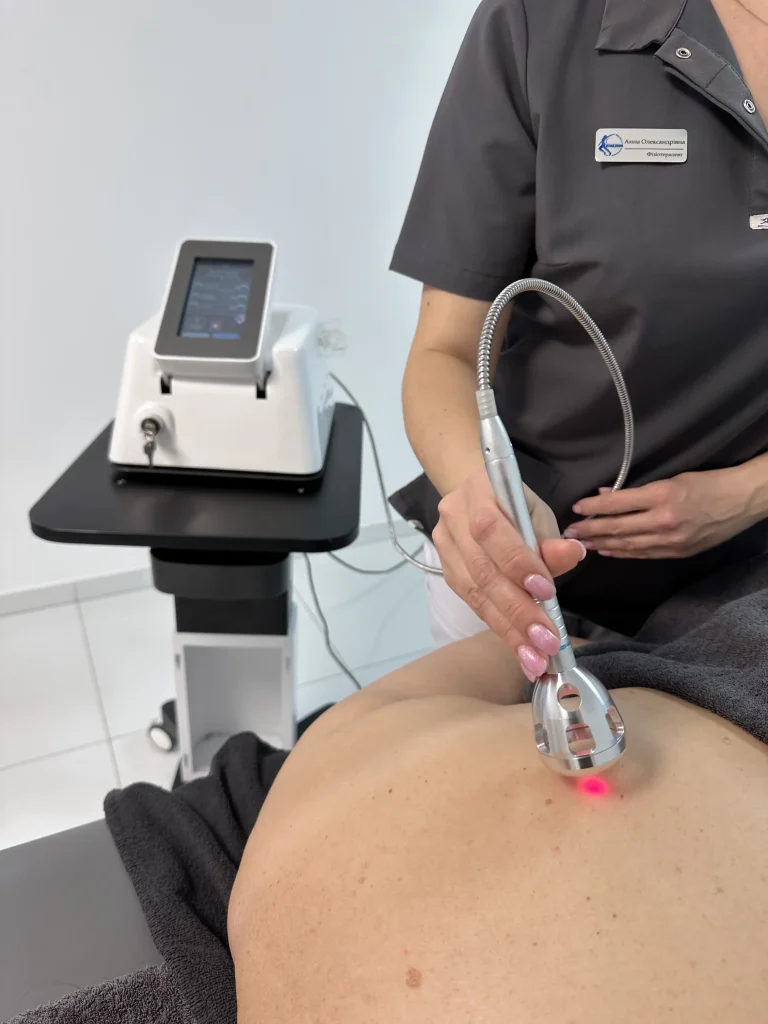
 Laser therapy is a modern physiotherapy method that uses focused laser light of low or medium power to repair tissues, reduce pain and relieve inflammation.
The laser works pointwise and deeply, penetrating to the cellular level, where it triggers natural regeneration mechanisms. Focused light improves microcirculation, stimulates collagen synthesis and accelerates metabolic processes necessary for the restoration of muscles, ligaments, skin and other tissues.
Procedure painless, does not require injections, medications or anesthesia, and is used for both acute injuries and chronic diseases.
Under the influence of a laser beam:
Capillaries dilate → blood and oxygen supply improves
Inflammation is reduced due to the regulation of cellular metabolism
Accelerates cell regeneration and tissue healing
Pain sensitivity decreases nerve endings
Intensifies removal of toxins and inflammation products
The body launches its own mechanisms to restore the area affected by injury, stress, or overload.
Benefits of laser therapy
Painless — only pleasant warmth is felt
Without medication and chemical intervention
Deep action — effective where creams or regular massage do not help
Suitable for acute and chronic conditions
Can be used on small and large joints
Goes well with exercise therapy, TEKAR, UHT, massage, manual therapy
Does not require restoration — return to activity immediately after the procedure
arthrosis and arthritis
pain in the knee, shoulder, elbow, hands
sprains and strains
osteochondrosis
muscle-fascial spasms
«"blocks" in the cervical-lumbar region
bruises, lacerations, hematomas
rehabilitation after operations
swelling
chronic inflammatory processes
scars, postoperative changes
We are grateful to everyone who has entrusted their health to us.
Your feedback is the best confirmation of the results of our work.
Share your impressions - they inspire us to become even better every day.
Leave your contacts — our specialist will contact you within 10–15 minutes to help you choose a service and answer all your questions.
We are always open for communication and ready to help you.
Call or email us to schedule a consultation or get detailed information.
Our experts will suggest the best solution for you.
Laser therapy at KINEZIUM is a physiotherapeutic technique using laser exposure to assist in pain, tissue and post-operative recovery. It can be considered for joint pain, muscle discomfort, local overload or as part of a rehabilitation program. It is important that laser therapy is not selected “by the name of the diagnosis”: before the procedure, complaints, area of effect, sensitivity, skin, contraindications and expected benefits are assessed. The procedure is of an auxiliary nature and does not replace exercise therapy, load control or medical treatment, if necessary. At KINEZIUM, laser therapy is included in the plan only when it corresponds to the patient's condition.
Laser physiotherapy may be useful for patients with joint pain, muscle discomfort, post-overuse conditions or rehabilitation tasks, when the technique is selected after consultation. It can be considered for local pain, stiffness, slow return of mobility or as an auxiliary component of a course of physiotherapy. If there is an acute infection, bleeding, oncological risks or skin lesions in the affected area, the procedure should be postponed or replaced.
Status or request | When laser therapy may be appropriate |
Joint pain | As an adjunctive procedure after evaluating the cause of pain |
Muscle discomfort | With local stress or overload without acute injury |
After injuries | Only after stabilization of the condition and checking for contraindications |
Rehabilitation course | As part of a program along with exercises and load control |
Local tissue inflammation | According to indications, without the promise of a guaranteed effect |
Back or neck pain | If there are no dangerous symptoms and the technique is appropriate according to the specialist's assessment |
Laser therapy can play a supporting role in reducing pain, supporting tissue repair, and working with the local inflammatory component. Some patients may experience improved range of motion or reduced discomfort after a course. However, the effect depends on the diagnosis, procedure parameters, duration of the course, tissue condition, and whether physiotherapy is combined with active rehabilitation. If the cause of the pain is weakness, instability, or improper dosage of the load, laser therapy will not replace exercise. The correct goal is to support the recovery process, not to guarantee a quick cure.
During laser therapy, joints, back, muscles, local painful areas and areas after injuries can be treated according to indications. The area of impact is determined after the examination: the specialist clarifies where there is pain, whether there is swelling, sensitivity, skin changes or contraindications. The laser cannot be directed into the eyes, and when working near the face or neck, especially careful control is required. The laser is not used on areas of active infection, open wounds or suspicious neoplasms without medical permission. If the area of pain is unclear, diagnostics are required first.
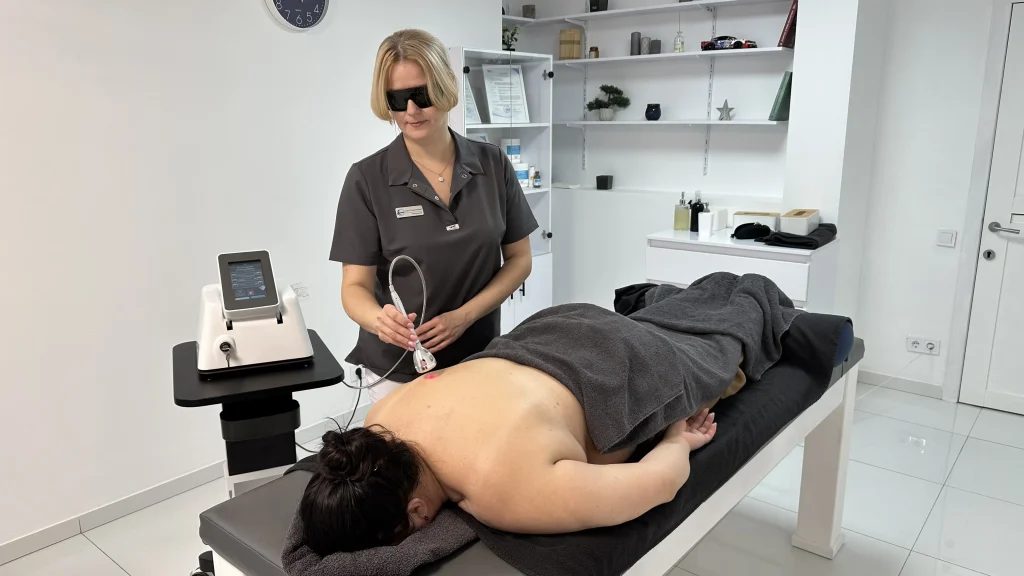
Laser therapy at the KINEZIUM center in Kyiv begins with a consultation, clarification of complaints, selection of the zone and checking for contraindications. The specialist adjusts the parameters of the procedure, determines the duration of the session and explains what sensations to expect. During laser therapy, the patient usually should not feel sharp pain; sometimes a slight warmth or minimal sensations are possible depending on the type of equipment. After the procedure, recommendations are given regarding load, repeated sessions and combination with exercise therapy or other methods. If an unusual skin reaction, increased pain or discomfort occurs after the session, you should inform the specialist.
Laser therapy differs in the type of physical effect: it uses light energy, while electrotherapy works through currents, magnetotherapy through a magnetic field, and shock wave therapy through an acoustic wave. The sensations during the procedures are also different: laser is often tolerated gently, UHT can be more intense, and electrotherapy gives tingling or pulsation. The choice of technique depends on the task and contraindications.
Criterion | Laser therapy | Electrotherapy | Magnetotherapy | UHT |
Type of impact | Light energy | Electric currents | Magnetic field | Acoustic wave |
Feeling | Often minimal or mild heat | Tingling, pulsation | Usually faintly noticeable | More focused, intense impact |
Role in rehabilitation | Pain and tissue support | Pain, spasm, neuromuscular reactions | Auxiliary tissue support | Local tendon and fascial conditions |
Course | Individually selected | Individually selected | Individually selected | Often a course of several treatments |
Limitation | Eyes, cancer risks, pregnancy, skin, photosensitivity | Pacemaker, sensitivity, skin | Pacemaker, pregnancy, cancer risks | Blood clotting, pregnancy, thrombosis, infections |
Before laser therapy, it is necessary to take into account oncological risks, pregnancy for certain areas, acute infections, bleeding, skin lesions, photosensitivity, taking photosensitizing drugs and the need for eye protection. The laser beam is not directed into the eyes, and appropriate safety measures are used when working near the face. Caution is also required in case of unexplained pain, suspicious skin formations, sensitivity disorders or active inflammation.
Cochrane, in a review of low-level laser therapy for low back pain, notes that small studies have shown some pain reduction, but the effect was small and protocols varied: https://www.cochrane.org/evidence/CD005107_low-level-laser-therapy-low-back-pain. A PubMed Central review of low-level laser therapy describes potential mechanisms and possible clinical applications, but emphasizes the need for proper parameters and safety: https://pmc.ncbi.nlm.nih.gov/articles/PMC4743666/. The PubMed Central article “Low-Level Laser Therapy: Potential and Complications” reminds us that laser therapy has potential, but also requires consideration of possible complications and contraindications: https://pmc.ncbi.nlm.nih.gov/articles/PMC8558713/. Therefore, laser therapy should be performed after a risk assessment, and not as a universal procedure.
After laser therapy at KINEZIUM, you can expect a gradual effect: reduced discomfort, better tolerance of movement or support for tissue repair. But the result depends on the diagnosis, duration of the problem, the course of procedures, individual reaction and combination with rehabilitation. If the patient does not change the load, does not perform exercises or continues to provoke the symptom, the effect may be short-lived. Laser therapy should be part of a plan, not the only answer to pain.
The NCCIH, in its material on low back pain, mentions low-level laser therapy among the approaches that have been studied for pain, but such methods require careful interpretation of the evidence: https://www.nccih.nih.gov/health/low-back-pain-and-complementary-health-approaches-what-you-need-to-know. Cochrane notes that for low back pain, evidence on LLLT is limited by small studies and varying treatment regimens: https://www.cochrane.org/evidence/CD005107_low-level-laser-therapy-low-back-pain. A PubMed Central review of laser therapy for musculoskeletal conditions highlights the importance of parameters and combination with other modalities: https://pmc.ncbi.nlm.nih.gov/articles/PMC4743666/. Practical conclusion: the laser can be an auxiliary tool, but the result must be evaluated in the dynamics of function, pain, and movement.
The price of laser therapy in Kyiv depends on the area, number of procedures, duration of the course, complexity of the condition and the need for a preliminary consultation. If laser therapy is part of a comprehensive program with exercise therapy, massage or other physiotherapy procedures, the total cost is formed more broadly. To register with KINEZIUM, you need to report the complaint, diagnosis, area of pain, previous examinations, skin problems, pregnancy, oncological risks or photosensitivity. After the assessment, the specialist will determine whether the procedure is suitable, how many sessions may be required and how to monitor the result. This will help to choose a course without unnecessary or dangerous procedures.
Leave your contacts — our specialist will contact you within 10–15 minutes to help you choose a service and answer all your questions.
Leave your contacts - our specialist will contact you within 10-15 minutes to help with the service and answer all your questions.