
 Skip to content
Wellness centers
Patients were helped
Specialists
Years of experience
TECAR therapy is a modern method of deep restoration of muscles, ligaments and joints using high-frequency electromagnetic energy. It works inside the tissues, improves blood circulation, nutrition and regeneration — without pain, without injections and without a long rehabilitation period.
This is a therapy that stimulates the body's natural recovery mechanisms and is used in sports medicine, orthopedics, and physical rehabilitation.
Relieves pain and spasm
Reduces swelling and inflammation
Accelerates healing after injuries
Restores joint mobility
Relaxes deep muscles, inaccessible to other methods
The therapy is effective for:
chronic pain
cramps and strain
arthrosis
tendon and ligament injuries
«"stuck" shoulder
heel spur
consequences of sports activities
overload after training
recovery from injuries
| Stage | Result |
|---|---|
| 1 session | noticeable reduction in pain and tension |
| 3–5 sessions | restoration of mobility |
| 6–8 sessions | stable and long-lasting result |
Duration of the procedure: 20–30 min
Recommended frequency: 2–3 times a week
We are grateful to everyone who has entrusted their health to us.
Your feedback is the best confirmation of the results of our work.
Share your impressions - they inspire us to become even better every day.
Leave your contacts — our specialist will contact you within 10–15 minutes to help you choose a service and answer all your questions.
We are always open for communication and ready to help you.
Call or email us to schedule a consultation or get detailed information.
Our experts will suggest the best solution for you.
TECAR therapy at KINEZIUM is a high-frequency physiotherapy technique used to work with tissues, pain, muscle tension and recovery after exertion. The method belongs to the capacitive-resistive energy transfer / TECAR approaches and involves the use of electromagnetic energy for a controlled effect on tissues. The procedure may cause a feeling of warmth, so its parameters and regimen should be selected individually. Before the session, it is important to assess contraindications: pacemaker, pregnancy, oncological risks, bleeding, impaired sensitivity or active inflammation. TECAR does not replace rehabilitation exercises, but can be part of a recovery program.
High-frequency therapy may be suitable for muscle tension, joint or back pain, recovery from overuse injuries, and the need for hardware physiotherapy. It may be considered for localized areas where tissue and range of motion are needed. However, the procedure is not suitable for a number of conditions, so it should not be chosen on your own without an evaluation.
Status or request | When TECAR may be appropriate |
Muscle tension | As an auxiliary work with tissues after assessing the condition |
Back pain | As part of comprehensive rehabilitation with exercises and load control |
Joint pain | If there is no acute inflammation, infection or contraindications |
After overloads | To support local zone recovery |
Tendon discomfort | According to indications, without the promise of a guaranteed effect |
The need for hardware physiotherapy | When the technique corresponds to the diagnosis, the area and the patient's safety |
Electromagnetic therapy in the TECAR format can play a supporting role in reducing discomfort, supporting tissue repair and improving range of motion. The feeling of warmth and mechanical work of the device can help reduce feelings of stiffness or tension. However, if the cause of the pain is weakness, instability, impaired movement technique or overload, exercises and load changes are needed. TECAR should be considered as part of a broader plan, not an isolated method. The result depends on the parameters of the procedure, course, diagnosis and tissue response.
During tekar therapy, the back, joints, muscles, tendons and local areas after injuries or overloads can be treated according to indications. The area is determined after examination, because the same complaint can have different causes. Before the procedure, the skin, sensitivity, the presence of metal implants in the area of impact, pacemaker or other electronic devices are checked. If there is acute inflammation, bleeding, a wound or severe pain of unknown origin in the area, the procedure is not performed without medical evaluation. The patient should report excessive heat, burning or discomfort during the session.
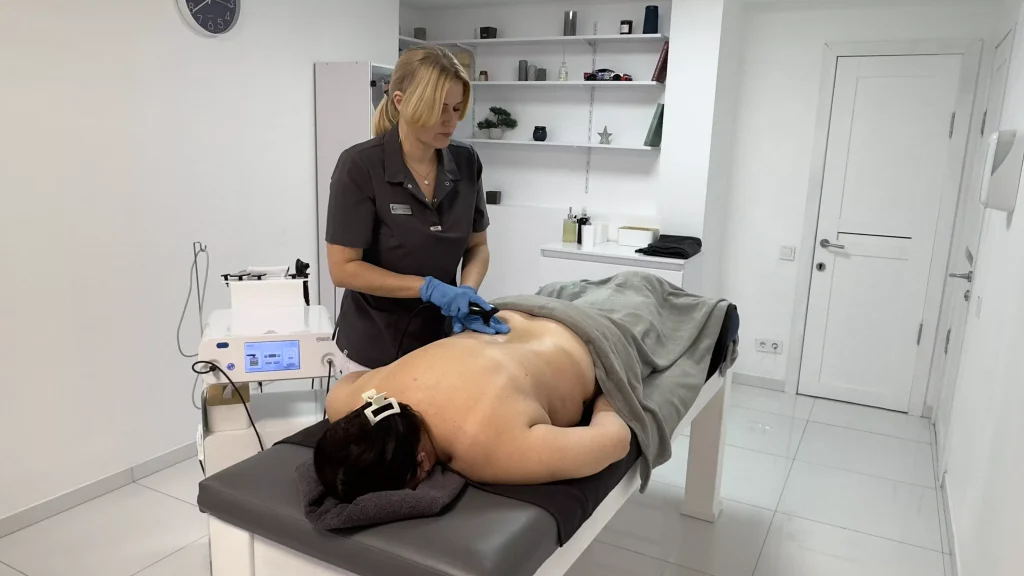
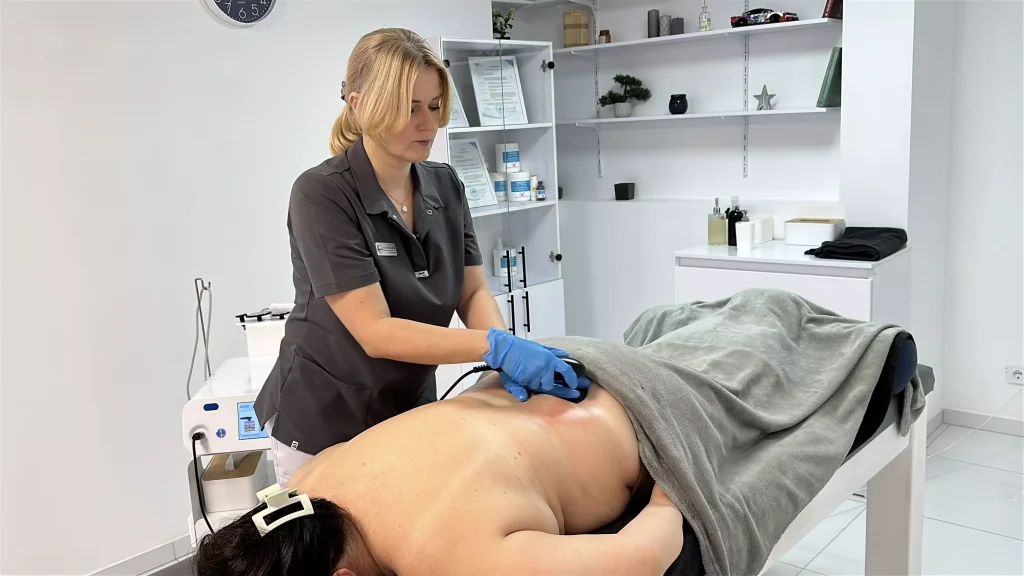
Tecar therapy at the KINEZIUM center in Kyiv begins with an assessment of the condition, selection of the regimen, the area of exposure, and checking for contraindications. The specialist applies a contact agent, adjusts the device, and works on a specific area with sensation control. The patient may feel warmth, gentle pressure, or movement of the applicator over the tissues. The intensity should remain comfortable: burning, sharp pain, or dizziness are not a normal reaction. After the procedure, recommendations are given regarding activity, repeated sessions, and combination with exercise therapy or other methods.
TECAR therapy is different in that it uses high-frequency electromagnetic energy and is often accompanied by a feeling of warmth in the tissues. Electrotherapy is usually felt as a tingling or pulsation, laser therapy as a light effect, and UHT as an intense acoustic wave. TECAR is more often used for local work with tissues, muscles, tendons or overload areas.
Criterion | Tecar therapy | Laser therapy | Electrotherapy | UHT |
Type of impact | High-frequency electromagnetic energy | Light energy | Electric currents | Acoustic wave |
Feeling | Heat, contact effect | Often minimal | Tingling, pulsation | Intense point effect |
Zones | Muscles, tendons, joints, back | Local tissues | Muscles, neuromuscular zones | Tendons, fascia, entheses |
Role | Auxiliary fabric work | Pain management | Pain, spasm, stimulation | Chronic local overloads |
Limitation | Pacemaker, pregnancy, cancer risks, bleeding, sensitivity | Eyes, cancer risks, skin | Pacemaker, skin, sensitivity | Coagulation, thrombosis, pregnancy, infections |
Before Tecar therapy, it is necessary to consider pacemakers, implanted electronic devices, pregnancy, acute inflammation, oncological risks, bleeding, sensory disturbances, active thrombosis, skin lesions and metal implants in the affected area if necessary. Since the procedure can create a thermal effect, it is dangerous to work on areas where the patient does not feel temperature well or has vascular risks. If there is severe pain, swelling, redness or fever, a medical evaluation is required first.
The PubMed Central review “TECAR Therapy: A Clinical Commentary” notes that TECAR is contraindicated during pregnancy, and patients with pacemakers or other implanted electronic devices should avoid the procedure: https://pmc.ncbi.nlm.nih.gov/articles/PMC11964684/. The PubMed Central article on TECAR and high-intensity laser therapy also lists pregnancy as a contraindication and emphasizes the need for safe patient selection: https://pmc.ncbi.nlm.nih.gov/articles/PMC9604865/. MedlinePlus describes symptoms of deep vein thrombosis that require medical evaluation before any tissue-intensive procedures: https://medlineplus.gov/deepveinthrombosis.html. Therefore, TECAR should only be started after checking the devices, vascular risks, and sensitivity.
After the kinesio therapy in KINEZIUM, you can expect a gradual decrease in discomfort, a feeling of softer tissues, support for recovery and better tolerance of movement. The effect depends on the diagnosis, course, device mode, intensity and combination with physical rehabilitation. If the problem is related to weakness, movement technique or chronic overload, it is advisable to supplement the procedure with exercises. The result should be evaluated not only by the feeling of warmth after the session, but also by how movements, pain and function change.
A PubMed Central systematic review of capacitive and resistive electric transfer therapy describes TECAR as a method being studied for musculoskeletal pain, but results depend on the protocols and quality of the studies: https://pmc.ncbi.nlm.nih.gov/articles/PMC9838110/. A PubMed Central clinical commentary on TECAR emphasizes that the technique is evolving and requires correct application in a rehabilitation context: https://pmc.ncbi.nlm.nih.gov/articles/PMC11964684/. The NCBI Bookshelf on Physical Therapy reminds us that physical therapy interventions work best when combined with exercise and patient education: https://www.ncbi.nlm.nih.gov/books/NBK561514/. Practical conclusion: TECAR can be a useful adjunctive procedure, but does not replace active recovery.
The price of TECAR therapy in Kyiv depends on the number of procedures, area, duration, device mode, complexity of the condition and need for consultation. If TECAR is included in a comprehensive program with exercise therapy, massage or other physiotherapy procedures, the total cost is calculated according to the plan. To sign up for KINEZIUM, you should report the complaint, pain area, presence of a pacemaker, metal implants, pregnancy, vascular risks, skin lesions or sensitivity disorders. After the assessment, the specialist will determine whether the procedure is suitable, which mode to choose and how many sessions may be required. This helps to make the course safe and expedient.
Leave your contacts — our specialist will contact you within 10–15 minutes to help you choose a service and answer all your questions.
Leave your contacts - our specialist will contact you within 10-15 minutes to help with the service and answer all your questions.