 Skip to content
 Wellness centers
Patients were helped
Specialists
Years of experience
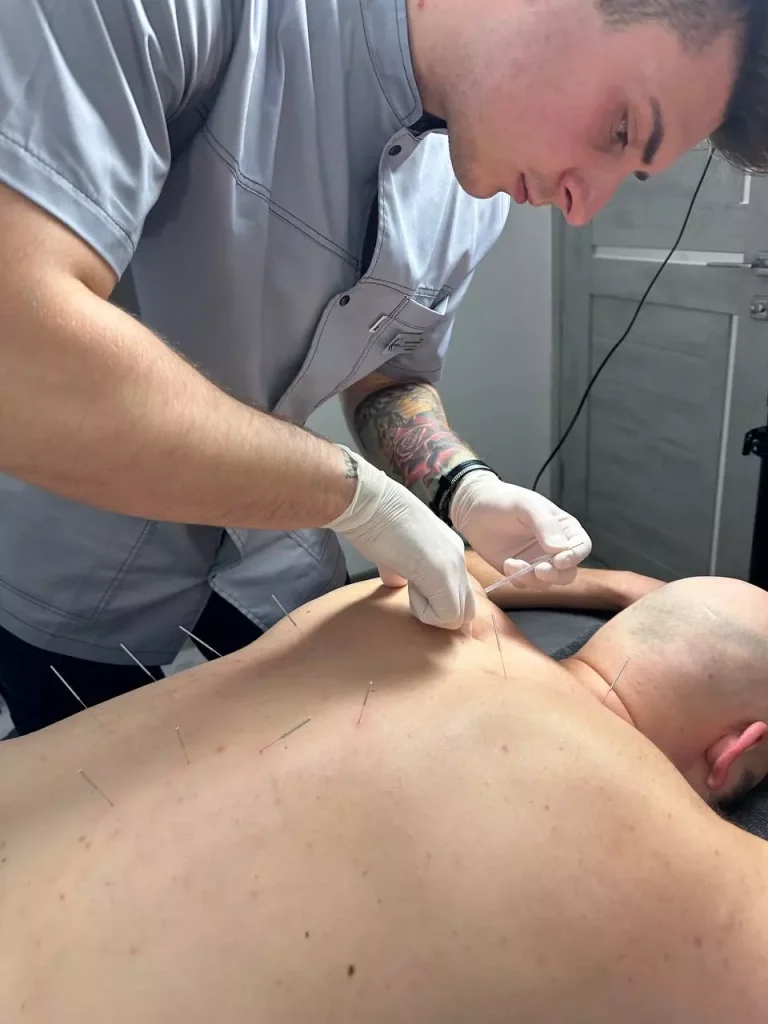
Acupuncture is a method in which ultra-fine sterile needles are injected into biologically active points to affect the nervous, muscular, endocrine and immune systems.
Procedure not painful — needle thinner than a hair, and the effect is often felt after the first session.
reduces acute and chronic pain
works even where medications are ineffective
helps with back pain, neck pain, joint pain, headaches, neuralgia
reduces stress and anxiety levels
improves sleep quality
stabilizes the emotional background
promotes a sense of inner peace
improves muscle and tissue nutrition
accelerates recovery after injuries and surgeries
helps reduce swelling
relieves deep muscle spasms
relaxes trigger points
improves mobility of the spine and joints
normalizes the work of the autonomic nervous system
has a positive effect on the digestive, hormonal, cardiovascular and respiratory systems
strengthens the body's natural defenses
helps to recover faster
osteochondrosis, hernias, protrusions
radiculitis, lumbalgia, acute and chronic back pain
migraine, tension headaches
neuralgia (trigger nerve, intercostal)
joint pain: arthritis, arthrosis
paresis, muscle weakness
numbness, loss of sensation
vegetative-vascular dystonia (VVD)
neuropathy (including diabetic - on the recommendation of a doctor)
chronic stress and overexertion
sleep disturbance
panic attacks (as part of complex therapy)
increased anxiety, emotional exhaustion
gastrointestinal disorders
irritable bowel syndrome, stomach cramps
chronic bronchitis, asthenic conditions
post-traumatic pain
restoring mobility after injuries
muscle-tonic syndromes, "jamming"«
painful menstruation (dysmenorrhea)
PMS, menstrual irregularities
support for hormonal imbalances
reduction or disappearance of pain
deep relaxation and peace
sleep normalization
improving mobility and muscle tone
stabilization of emotional state
increased energy levels
Course: 6–12 sessions
Duration of 1 procedure: 20–40 min
First effect: after just 1–3 sessions
We are grateful to everyone who has entrusted their health to us.
Your feedback is the best confirmation of the results of our work.
Share your impressions - they inspire us to become even better every day.
Leave your contacts — our specialist will contact you within 10–15 minutes to help you choose a service and answer all your questions.
We are always open for communication and ready to help you.
Call or email us to schedule a consultation or get detailed information.
Our experts will suggest the best solution for you.
Acupuncture and acupuncture at KINEZIUM is a procedure using fine needles in specific areas of the body, which can be used as an auxiliary method in dealing with pain, muscle tension and functional discomfort. Before the session, it is important to assess the complaints, sensitivity, contraindications, medication intake and the purpose of the procedure. Acupuncture should not be presented as a universal treatment for all diseases, but can be part of a comprehensive recovery plan. The sensations during the procedure are usually individual: slight tingling, pressure, warmth or short-term discomfort. If there is a fear of needles, blood clotting disorders or skin infections, this should be discussed before the start.
Acupuncture may be appropriate for patients with muscle tension, back pain, localized functional discomfort, or the need for non-drug support as part of a rehabilitation plan. The technique may be considered when there is a clear goal: to reduce feelings of tension, support pain management, or supplement physical therapy and exercise. It is not the first choice for acute trauma, infection, neurological deterioration, or unexplained severe pain.
Status or request | When acupuncture may be appropriate |
Muscle tension | As an auxiliary method after assessing the condition of the tissues |
Back pain | Within a comprehensive program, if there are no “red flags” |
Functional discomfort | When symptoms do not require urgent medical attention |
Need for non-pharmacological support | If the procedure is agreed with a specialist and there are no contraindications |
Chronic pain | As one of the support options, without guarantee of the same effect |
Rehabilitation program | If acupuncture complements exercise, massage, or physical therapy |
Acupuncture can help work with pain, muscle spasm, a feeling of tension and support comprehensive rehabilitation. Some patients may experience a decrease in stiffness or discomfort after a session, but the response is individual. The technique does not replace exercise therapy if you need to restore strength, stability, gait or mobility of the joint. If the pain has a clear mechanical cause, overload or weakness, you need to work not only with the symptom, but also with the load. Therefore, acupuncture is better considered as an auxiliary tool, not as the only method.
Points and zones during acupuncture are selected depending on the complaints, localization of pain, sensitivity, general condition and the entire procedure. The specialist may work with areas of the back, neck, limbs or other areas, if this is in accordance with the plan. Before placing the needles, the skin condition is assessed, the presence of rashes, wounds, infections, bruises or vascular risks. The needles are not placed in areas with active inflammation, skin damage or sharp pain of unknown origin. During the session, the patient should report excessive pain, dizziness, nausea or weakness.
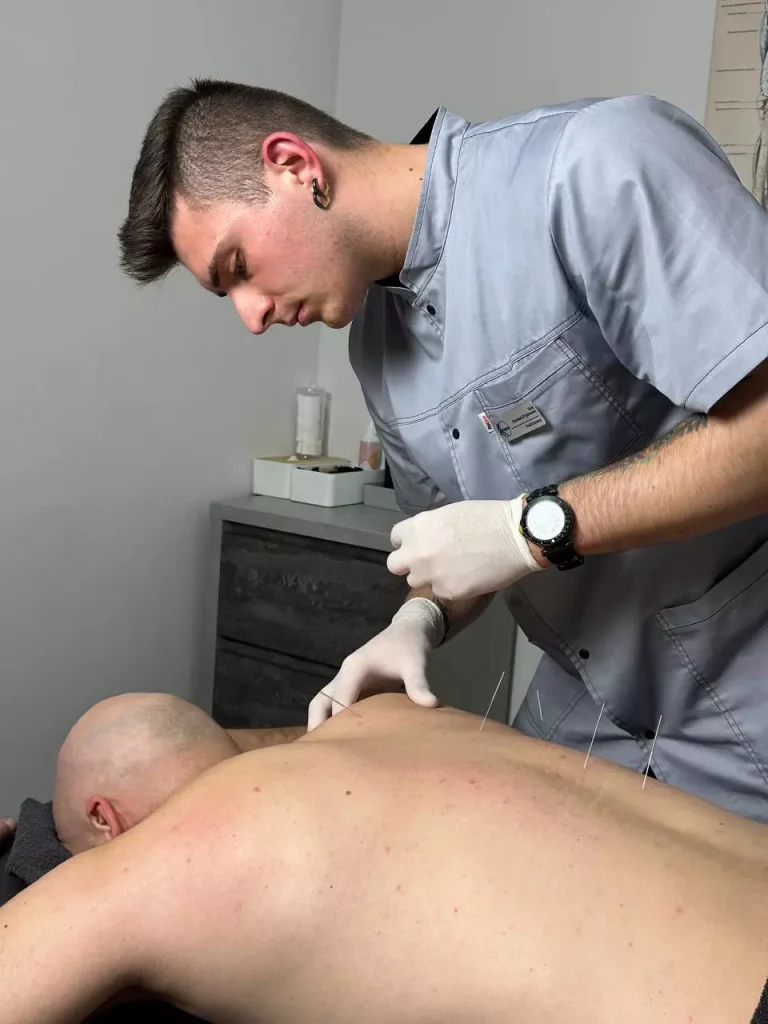
An acupuncture session at the KINEZIUM center in Kyiv begins with a consultation, assessment of the condition, clarification of complaints, contraindications, medications and previous experience with needle procedures. Then the specialist selects the areas of influence, explains the sensations, places the needles and monitors the patient's reaction. During the procedure, there may be sensations of pressure, tingling, warmth or slight distension, but sharp pain is not the norm. After the session, there may be recommendations regarding activity, water regime, monitoring of the reaction and combination with other recovery methods. If there is severe dizziness, bleeding, severe pain or signs of infection after the procedure, you should consult a specialist.
Acupuncture differs from physiotherapy and massage in the mechanism of action, invasiveness, and sensations during the procedure. Massage works through manual influence on soft tissues, physiotherapy through physical factors or hardware techniques, and acupuncture involves the insertion of thin needles into specific points. All of these methods can be helpful, but the choice depends on the condition, contraindications, and recovery goals.
Criterion | Acupuncture | Physiotherapy | Massage |
Type of impact | Fine needles in selected areas | Hardware or physical factors | Handmade with soft fabrics |
Invasiveness | Minimally invasive procedure | Usually non-invasive | Non-invasive |
Feeling | Tingling, pressure, warmth, mild discomfort | Depends on the methodology | Pressure, kneading, relaxation |
Role in the plan | Helping with pain and tension | Support for pain, tissue, swelling | Reducing muscle tension |
Limitation | Blood clotting, skin infections, fear of needles, pregnancy for specific points | Method-specific contraindications | Injuries, inflammation, vascular risks, skin |
Before acupuncture, it is necessary to take into account blood clotting disorders, taking anticoagulants, skin infections, open wounds, fear of needles, a tendency to faint, pregnancy for certain points, acute conditions, immunodeficiency, oncological risks and severe unexplained pain. If there is a fever, active infection, skin lesions in the area of needle placement or significant bleeding, the procedure should be postponed. It is also important to inform the specialist about all medications and previous reactions to injection or needle procedures.
The NCCIH notes in its material on acupuncture that the risks of acupuncture are low when performed by a competent practitioner with sterile needles, but complications are possible if performed incorrectly: https://www.nccih.nih.gov/health/acupuncture-what-you-need-to-know. The FDA regulates acupuncture needles as medical devices that must be sterile and intended for single use: https://www.fda.gov/medical-devices/acupuncture-needles. MedlinePlus, in its article on back pain, states that certain symptoms require a medical evaluation, not just symptomatic treatments: https://medlineplus.gov/ency/article/007425.htm. Therefore, acupuncture should be performed with consideration of sterility, contraindications, and clinical context.
After acupuncture in KINEZIUM, you can expect a possible reduction in pain, tension or subjective discomfort, but the result depends on the condition, the course of the procedures, the reaction of the nervous system and the combination with other methods. In some patients, the effect may be noticeable after several sessions, in others - weaker or absent. If the symptoms are associated with weakness, instability or motor deficit, exercises and rehabilitation are required.
The NCCIH/NIH reports that acupuncture has been studied for various types of pain, including back, neck, and knee pain, but effectiveness varies depending on the condition and quality of the studies: https://www.nccih.nih.gov/health/acupuncture-what-you-need-to-know. A PubMed Central review of acupuncture for chronic pain demonstrates that the method may have modest benefits for specific pain conditions, but is not a universal guarantee: https://pmc.ncbi.nlm.nih.gov/articles/PMC5927830/. JAMA Internal Medicine, in a meta-analysis of individual patient data, also describes the benefits of acupuncture for chronic pain, but the effect must be evaluated in the context of a specific patient: https://jamanetwork.com/journals/jamainternalmedicine/fullarticle/1357513. Practical conclusion: acupuncture can be an auxiliary method in the recovery plan, if there are indications and safe conditions.
The price of acupuncture in Kyiv depends on the duration of the session, the number of zones, the course of procedures, the complexity of the condition and the need for an initial consultation. If the procedure is performed as part of a comprehensive rehabilitation, the plan may also include physiotherapy, exercise therapy, massage or a doctor's consultation. To register with KINEZIUM, you need to report the complaint, the duration of symptoms, medications, allergies, blood clotting problems, pregnancy or fear of needles. After the assessment, the specialist will explain whether acupuncture is appropriate, how many sessions may be needed and what restrictions to take into account. This helps to determine the cost not in the abstract, but for a specific request.
Leave your contacts — our specialist will contact you within 10–15 minutes to help you choose a service and answer all your questions.
Leave your contacts - our specialist will contact you within 10-15 minutes to help with the service and answer all your questions.