wellness centers
patients were helped
specialists
years of experience
Rehabilitation specialist — is a specialist who restores motor functions after injuries, surgeries, and chronic diseases of the musculoskeletal system and nervous system. His task is not just to relieve pain, but to return a person to a full, active life.
back, neck, joint pain
numbness, weakness, limited movement
consequences of injuries and surgeries
Posture and gait disorders
recovery after arthroplasty
chronic pain syndromes
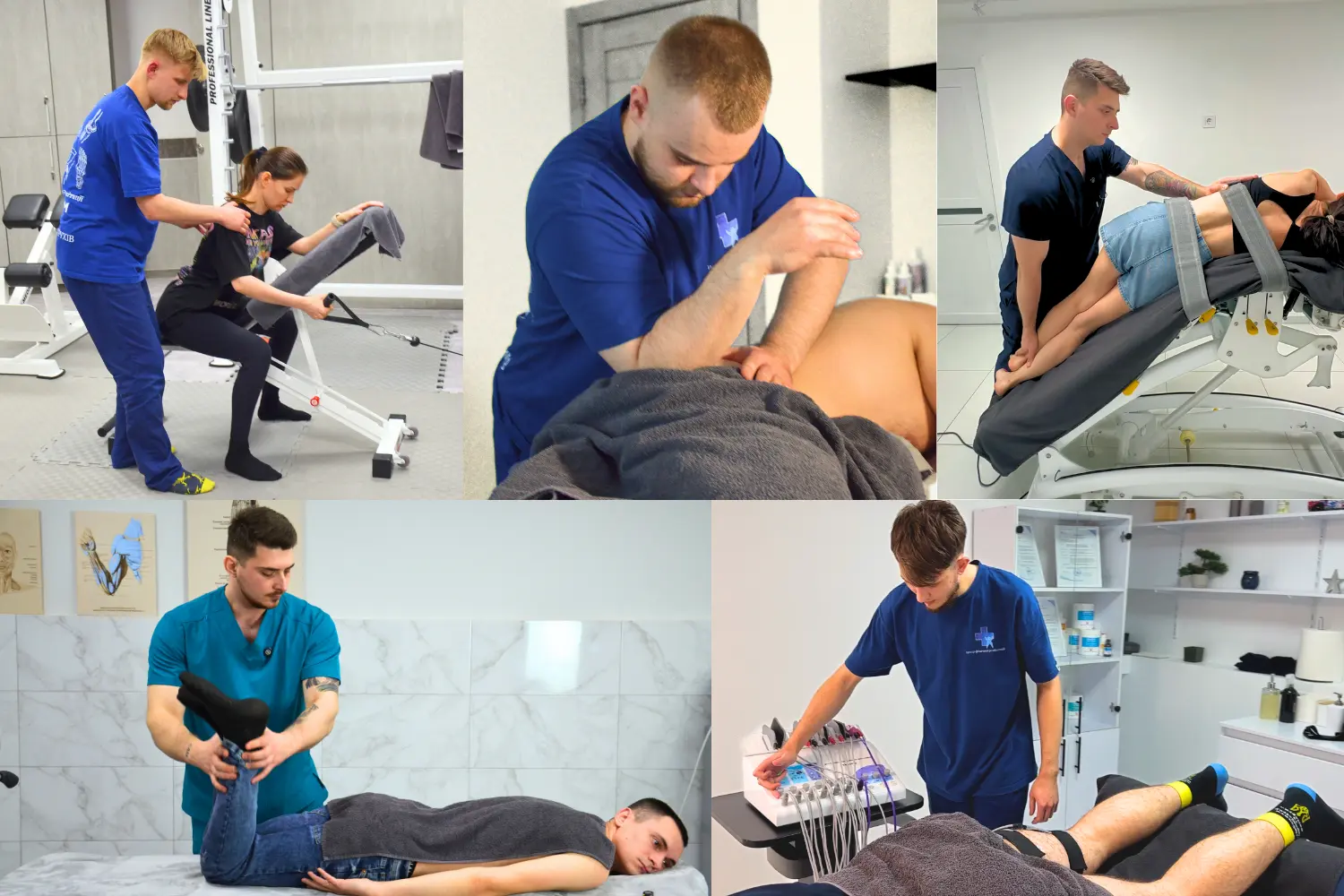
A rehabilitation therapist works with the cause of the problem by assessing the movement, stability, and biomechanics of the body:
conducts functional diagnostics
assesses muscle balance and movement patterns
defines restrictions and overload zones
forms an individual rehabilitation plan
Recovery is gradual and safe:
Physical therapy (physical therapy) — the basis of rehabilitation and stable results
Hardware methods — to reduce pain and speed up recovery
Working with posture and gait — normalization of loads
Teaching correct movements in everyday life — prevention of recurring problems
Constant dynamics monitoring — program correction as needed
💡 The result of working with a rehabilitation specialist — reducing or eliminating pain, restoring mobility, strength, and confidence in movement.

Leave your contacts — our specialist will contact you within 10–15 minutes to help you choose a service and answer all your questions.
A rehabilitation consultation at KINEZIUM is an initial assessment of the patient's movement, pain, strength, function and goals before starting recovery. The rehabilitation specialist helps to understand why movement is limited, what loads are now safe, what exercises are needed and whether it is worth connecting physiotherapy, massage or a doctor's consultation. This approach is especially important after injuries, surgeries, fractures, long-term pain in the back, joints or muscles. The specialist does not just give a "set of exercises", but forms a plan with gradual progression. The goal is to restore function without overload and understand what exactly should change from visit to visit.
A rehabilitation specialist's examination is needed by patients after injuries, surgeries, back pain, joints, muscles, movement restrictions, weakness or gait disorders. If the patient does not understand what exercises can be performed, whether it is possible to load the leg or arm, how to return movement without pain - a consultation helps to determine a safe start. This is especially important after a cast, endoprosthetics, arthroscopy, sports injuries, exacerbations of back pain or prolonged immobility.
Situation | Why do you need an examination by a rehabilitation specialist? |
After injury | Determine safe traffic and load levels |
After surgery | Consider postoperative restrictions and surgeon's protocol |
Back pain | Assess movement, strength, symptoms, and overload factors |
Joint pain | Choose exercises for mobility, stability, and pain control |
Muscle weakness | Create a gradual strengthening program |
Gait disturbance | Check support, balance, coordination, and risk of falls |
The initial visit to a rehabilitation specialist includes taking a medical history, analyzing complaints, assessing movements, testing strength, checking pain, balance, gait, functional limitations, and contraindications. If the patient has an MRI, CT scan, X-ray, post-operative discharge, or doctor's recommendations, this information helps to make the program more accurate. After the examination, the specialist determines what exercises, procedures, or additional consultations are needed.
Reception stage | What is being assessed? | Why is this needed? |
History taking | Injuries, surgeries, pain, examinations, medications | To understand the clinical context |
Movement assessment | Amplitude, stiffness, compensatory movements | To find functional limitations |
Strength testing | Muscle weakness, asymmetry, control | To choose your exercise level |
Assessment of gait or arm function | Support, balance, coordination, everyday movements | To work with real actions |
Procedure plan | Exercise therapy, physiotherapy, massage, home exercises | To form a consistent recovery path |
The rehabilitation specialist develops an individualized plan based on the patient's diagnosis, pain level, load tolerance, mobility, strength, goals, and medical limitations. If the patient is post-operative, the surgeon's recommendations will be the first priority; if there are neurological symptoms, a more cautious pace and possibly consultation with an allied health professional are needed. The plan may include range-of-motion, strength, balance, coordination, gait training, physiotherapy, or soft tissue work. It is important that the program has progress criteria: what needs to improve, when to increase the load, and when to stop.
MedlinePlus describes physical medicine and rehabilitation as a specialty that helps people restore body functions lost due to illness or injury: https://medlineplus.gov/ency/article/007448.htm. The University of Minnesota PM&R emphasizes the interdisciplinary nature of rehabilitation services for people with physical disabilities and recovery needs: https://med.umn.edu/rehabmedicine/about/divisions/physical-medicine-rehabilitation. NCBI Bookshelf, in the material “Therapeutic Exercise”, describes therapeutic exercise as intended movement to correct disorders and restore musculoskeletal function: https://www.ncbi.nlm.nih.gov/books/NBK555914/. This explains well why rehabilitation should combine assessment, movement, safety control and a team approach, rather than consist of random exercises.
Acute pain, significant swelling, postoperative restrictions, incomplete bone union, neurological symptoms, numbness, progressive weakness, risk of falling, cardiovascular limitations, fever, or signs of infection should be discussed before starting rehabilitation. If there is any doubt about the permissible load after surgery or fracture, a doctor's consultation or clarification of the protocol is required. Sometimes, instead of active training in the first stage, additional examinations, medical evaluation, or a very gentle start are required.
MedlinePlus explains in its article on rehabilitation that the plan depends on the cause of the problem, the severity of the condition, and the abilities lost: https://medlineplus.gov/rehabilitation.html. MedlinePlus notes in its recommendations after a fracture that physical therapy or gentle exercise may be recommended to prevent weakness or stiffness, but this should be consistent with the state of healing: https://medlineplus.gov/ency/patientinstructions/000522.htm. NCBI Bookshelf, in its article on therapeutic exercise, emphasizes that exercise should be a purposeful movement for a specific functional purpose, not a random load: https://www.ncbi.nlm.nih.gov/books/NBK555914/. Therefore, discussing limitations is part of safe rehabilitation, not a formality.
To sign up for a consultation with a rehabilitation specialist in Kyiv, you need to contact KINEZIUM and briefly describe your complaint: pain, injury, surgery, movement restrictions, weakness, gait disturbance, or the need for a recovery program. For the first visit, you should bring the results of examinations, discharge notes, doctor's recommendations, and information about the permitted load. After the consultation, the patient receives an action plan: what exercises are needed, whether to add physiotherapy or massage, how often to exercise, and what limitations to consider. According to the information provided, the advantages of KINEZIUM are 2 centers, 50+ specialists, 13+ years of experience, and a Google rating of 4.8. This is convenient when you need to go from assessment to supervised recovery in one center.
Leave your contacts — our specialist will contact you within 10–15 minutes to help you choose a service and answer all your questions.