
 Skip to content
 Wellness centers
Patients were helped
Specialists
Years of experience
Traumatologist is a doctor who specializes in the diagnosis and treatment of injuries to the musculoskeletal system: bones, joints, ligaments, tendons, and muscles.
The main task of a traumatologist is not only to eliminate the consequences of the injury, but also to ensure the correct, safe, and full restoration of the function of the affected area.
Referral to a traumatologist is recommended in the following cases:
• acute pain after a fall or impact;
• sprains, tears, injuries to ligaments and tendons;
• bruises, dislocations, fractures;
• pain and swelling in the joint after physical exertion;
• limited mobility after injuries;
• preparation for rehabilitation and monitoring of recovery after surgical interventions.
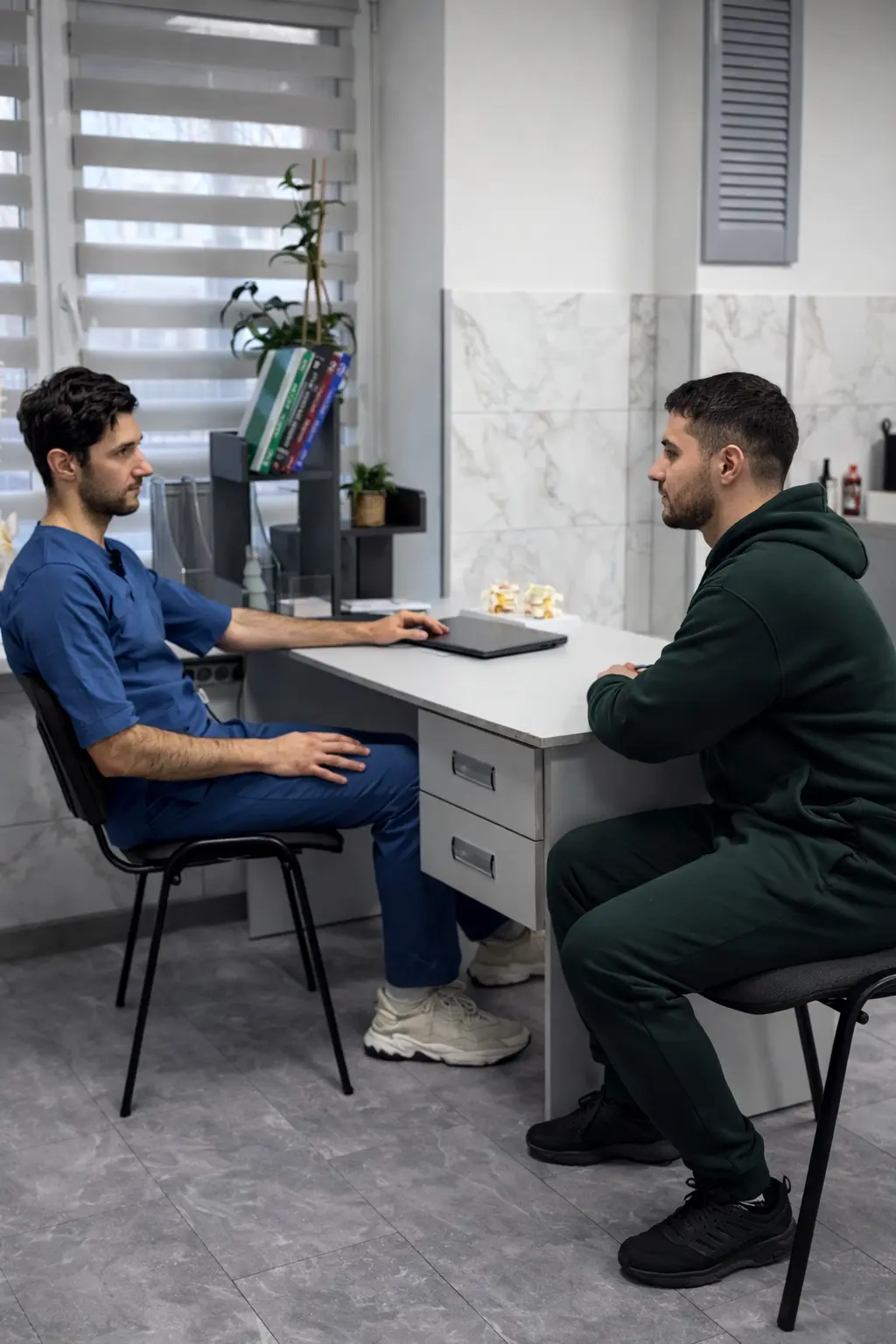
During the consultation, the doctor determines the nature and extent of the injury:
• clinical examination and functional tests;
• assessment of joint and musculoskeletal stability;
• analysis of X-ray, MRI or CT scan results (if necessary);
• determining the risks of complications and repeated injuries;
• formation of recommendations for treatment and further rehabilitation.
Injury treatment is carried out in combination with rehabilitation measures, which allows for a faster and safer return to active life:
• Apparatus physiotherapy — reduces pain, swelling and inflammatory processes;
• Therapeutic massage — improves blood circulation and promotes tissue regeneration;
• Physical therapy (physical therapy) — restores mobility, strength and stability of joints;
• Gradual return to exercise — under the constant supervision of a specialist;
• Individual recovery program — taking into account the type of injury, age and lifestyle of the patient.
💡 The result of working with a traumatologist — proper tissue healing, full restoration of joint and muscle function, and minimizing the risk of re-injury.
We are grateful to everyone who has entrusted their health to us.
Your feedback is the best confirmation of the results of our work.
Share your impressions - they inspire us to become even better every day.
Leave your contacts — our specialist will contact you within 10–15 minutes to help you choose a service and answer all your questions.
We are always open for communication and ready to help you.
Call or email us to schedule a consultation or get detailed information.
Our experts will suggest the best solution for you.
A consultation with a traumatologist at KINEZIUM is a medical assessment of the injury, pain, mobility, swelling, joint stability and the need for further procedures or examinations. The doctor helps to understand whether there is a suspicion of a fracture, sprain, damage to ligaments, tendons, joint structures or the consequences of overload. After the examination, tactics are formed: whether an X-ray, MRI, ultrasound, immobilization, drug support, physiotherapy or rehabilitation is needed. This technique is especially important after a fall, impact, sports injury, sharp pain or swelling. The purpose of the consultation is not only to make a preliminary conclusion, but also to determine a safe recovery route.
An orthopedic traumatologist appointment is necessary for patients after blows, sprains, fractures, joint pain, sports injuries, postoperative conditions or limited movement. Do not wait if the pain is severe, the limb is deformed, it is impossible to step on the foot, move the arm or there is significant swelling. In less acute situations, a consultation is necessary if the symptoms do not go away, recur during exertion or interfere with everyday activities.
Situation | Why is consultation needed? |
Impact or fall | It is necessary to exclude a fracture, dislocation or significant tissue damage. |
Stretching | It is important to assess the stability of the joint and the extent of the damage. |
Suspected fracture | Visualization and determination of further tactics are needed |
Joint pain | The doctor evaluates inflammation, injury, degenerative changes, or overload |
Sports injury | It is necessary to determine safe times for returning to work. |
After surgery | It is important to consider the surgeon's protocol and the rehabilitation phase. |
A visit to a traumatologist after an injury or joint pain includes a history, examination, mobility tests, assessment of pain, swelling, stability, support and function of the limb. The doctor analyzes when the symptom occurred, what is the mechanism of the injury, whether there is an inability to move, crunching, locking, numbness or weakness. If there are results of an X-ray, MRI, CT, ultrasound or discharge, they help to determine the tactics more accurately. After the examination, the patient receives recommendations for further examinations, treatment, restrictions, physiotherapy or rehabilitation.
Reception stage | What does a doctor do? | What does the patient receive? |
Collection of complaints | Clarifies pain, injury, swelling, movement restriction | Understanding which symptoms matter |
Review | Assesses joint, limb, axis, skin, swelling | The initial clinical picture |
Functional tests | Tests mobility, stability, resistance | Risk and limitation assessment |
Survey analysis | Reviews snapshots or findings | Clarification of the diagnostic route |
Plan | Recommends treatment, examination, or rehabilitation | The next step is clear. |
The traumatologist assesses the condition based on the mechanism of injury, level of pain, swelling, joint stability, range of motion, ability to bear weight, neurological symptoms, and examination findings. If a fracture, ligament tear, intra-articular injury, or infection is suspected, imaging or medical treatment may be the first step rather than active rehabilitation. Once acute risks have been ruled out or the condition has stabilized, the physician determines the allowable load, the need for physiotherapy, exercise therapy, or pain control. The plan should be appropriate for the healing phase: the early stage requires tissue protection, the later stage requires gradual return of strength, mobility, and function.
NCBI Bookshelf, in its article on physical interventions after traumatic injuries, considers rehabilitation as an important part of helping people with complex needs after injury: https://www.ncbi.nlm.nih.gov/books/NBK579685/. MedlinePlus describes rehabilitation as the process of regaining abilities lost after injury, illness, or treatment: https://medlineplus.gov/rehabilitation.html. The University of Colorado Anschutz Medical Campus in Physical Medicine and Rehabilitation describes rehabilitation as a field that helps patients restore function after illness or injury: https://medschool.cuanschutz.edu/physical-medicine-and-rehabilitation. Practical conclusion: a post-injury plan should combine medical safety, pain control, and gradual return to activity.
Before proceeding with post-traumatic procedures, consider the presence of severe pain, deformity, inability to bear weight, significant swelling, suspected fracture, numbness, weakness, open wound, fever, redness, signs of infection, or rapid deterioration of condition. In such situations, urgent care, imaging, immobilization, or another treatment route may be necessary. Physiotherapy, massage, or active exercise should not be initiated until dangerous injuries have been ruled out.
The NIAMS, in its material on sports injuries, notes that sudden severe pain, significant swelling, inability to support the joint, inability to move the joint normally, severe weakness, or visible deformity require medical evaluation: https://www.niams.nih.gov/health-topics/sports-injuries. MedlinePlus, in its article on joint pain, advises seeking medical attention if you have severe, unexplained pain, significant swelling, difficulty moving, or hot or red skin around a joint: https://medlineplus.gov/ency/article/003261.htm. AAOS OrthoInfo emphasizes in its patient materials that the tactics after an injury depend on the type of injury, severity, and the need for immobilization or treatment: https://orthoinfo.aaos.org/. Therefore, before procedures, it is important to first determine whether urgent medical action is needed.
The price of a traumatologist consultation in Kyiv depends on the format of the appointment, the primary or repeated visit, the complexity of the condition, the need for additional examinations and the further treatment plan. If a patient comes after an injury with swelling, pain and limited movement, the doctor may recommend an X-ray, MRI, ultrasound or consultation with an allied specialist. To register with KINEZIUM, you should briefly describe the injury, the date of onset of symptoms, the location of the pain, the presence of swelling, the possibility of support and previous examinations. It is advisable to bring pictures, statements and recommendations from doctors to the appointment, if they already exist. After the consultation, the patient receives a clear plan: what to check, what to limit and how to start recovery.
Leave your contacts — our specialist will contact you within 10–15 minutes to help you choose a service and answer all your questions.
Leave your contacts - our specialist will contact you within 10-15 minutes to help with the service and answer all your questions.