wellness centers
patients were helped
specialists
years of experience
Focused shockwave therapy is a modern treatment method that uses high-energy acoustic waves, directed at one point at a depth of up to 12 cm.
Unlike radial UHT, which affects mainly superficial tissues, The focused wave penetrates deeply and acts precisely on the source of pain..
Acoustic wave activates cell repair, improves microcirculation, reduces inflammation, and also triggers natural regeneration processes that the body has stopped performing due to overload, stress or injury.
Penetrates into deep structures: tendons, ligaments, joint capsules, deep trigger points
Has point action — the doctor directs energy to a specific area of pain, not «over the area»
Accelerates regeneration where blood circulation was reduced
Softens and destroys pathological formations (calcifications, fibrous bands)
Relieves pain without medication or injections
This is a technology that is widely used in professional sports and at complex injuries, when standard methods are no longer effective.
heel spur
plantar fasciitis
calcific tendonitis
chronic shoulder pain
«"runner's knee" (patellar syndrome)
tendinopathies after sports
achillodynia (Achilles tendon pain)
lower back, thigh, deep trigger points
post-traumatic changes, fibrosis, adhesions
If the pain lasts more than 6 weeks, focused X-ray therapy is one of the most effective treatment methods.
The effect is felt after 1st session
No surgery, no injections
Does not require a recovery period
Suitable even for those who have other methods didn't help
Safe, controlled and evidence-based methodology

Leave your contacts — our specialist will contact you within 10–15 minutes to help you choose a service and answer all your questions.
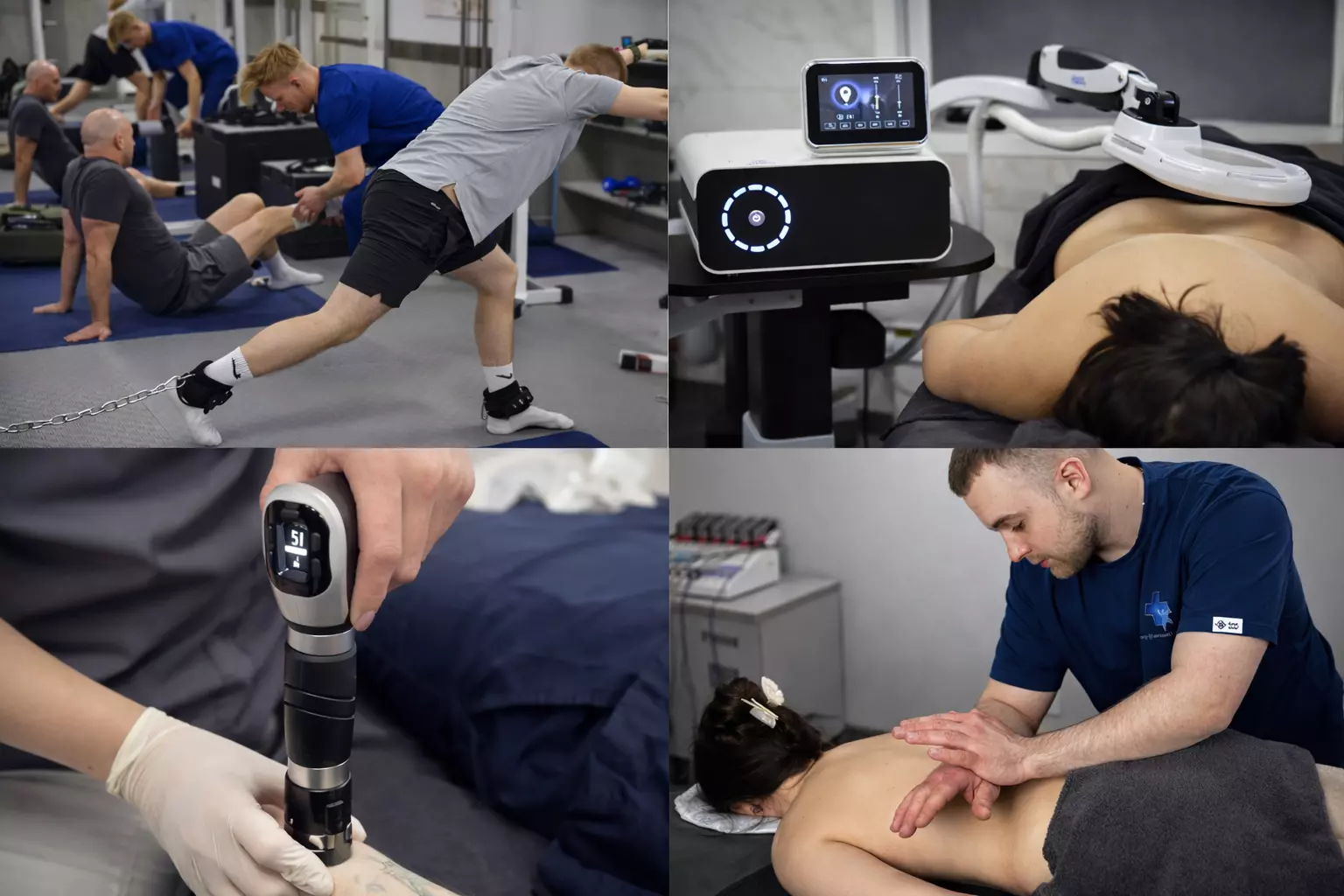
Focused shockwave therapy in KINEZIUM is a highly precise acoustic impact on deeper tissues, tendons, fascia, entheses or local painful areas after assessment of the condition. In contrast to the more diffuse impact, focused shockwave therapy allows you to direct energy to a more specific area and depth. It can be considered for local chronic pain, tendon or fascial conditions, if there are indications and no contraindications. The procedure should not be performed “blindly”: it is important to assess the source of pain, anatomical area, sensitivity, vascular and neurological risks. Focused shockwave therapy should be part of a plan that includes load control and rehabilitation exercises.
Focal shockwave therapy may be appropriate for patients with localized pain, tendon and fascial conditions, overuse, and the need for more precise treatment of a specific area. It may be considered when the pain is clearly localized and related to a specific tissue or enthesis. If symptoms are vague, acute, or accompanied by swelling, redness, fever, or neurological signs, a diagnosis is needed first.
Status or request | When focused UHT may be appropriate |
Local pain in the tendon | If the source of pain is identified and there are no signs of acute rupture |
Fascial pain | For chronic local discomfort after stress assessment |
Enthesopathies | When the pain is concentrated at the attachment site of a tendon or ligament |
Heel pain | If there are indications for a more precise impact on the fascia or enthesis area |
Deeper painful area | When greater precision and control of depth of impact is required |
Chronic overload | Within the framework of a program with exercises, dosage of load and correction of the cause |
FUHT can play a supporting role in reducing pain, stimulating tissue repair reactions, and working with local areas that have been responding to stress for a long time. It can be useful when it is necessary to more precisely influence the tendon, fascia, or enthesis, but only with proper patient selection. The technique is not a substitute for strength training, mobility exercises, balance, or a gradual return to activity. If the tissue continues to be overloaded daily, the effect of the procedure may be unstable. Therefore, the task of FUHT is to help within the framework of the plan, and not to solve the entire problem on its own.
Focused UHT can treat tendons, fascia, entheses, joint areas, and point pain areas as indicated. The specialist determines the depth, intensity, and target area after assessing pain, palpation, movement, and prior examinations. It is important to avoid areas where there is active infection, tumor, bleeding, thrombosis, or a high risk of neurovascular damage. If local pain has no clear cause, a focused procedure may be premature. First, it is necessary to determine which tissue is the source of the symptoms.
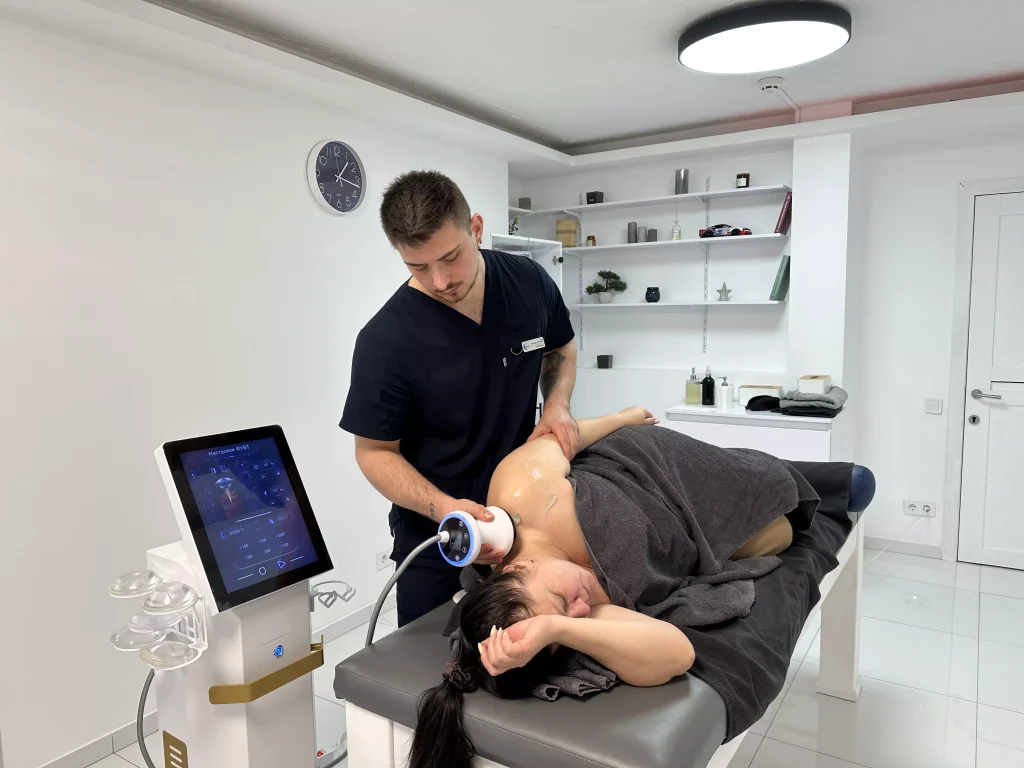
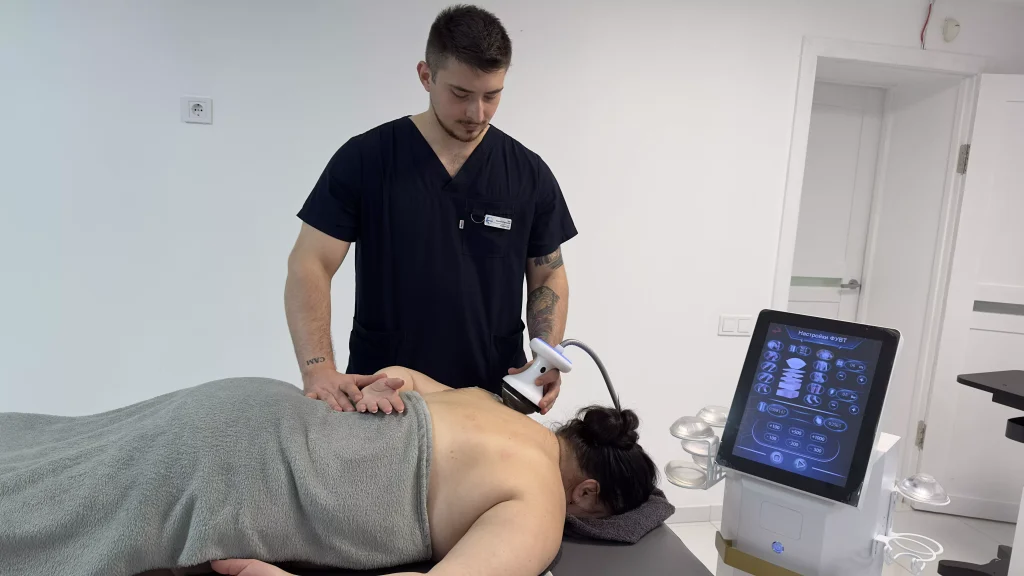
Focused UHT at the KINEZIUM center in Kyiv begins with a consultation, determination of the target area, checking for contraindications and explaining the sensations. The specialist adjusts the depth, intensity, number of pulses and position of the applicator. During the procedure, the sensations may be pinpoint and intense, but should remain controlled. After the session, there may be recommendations for temporary load limitation, exercises, repeated procedures and monitoring of tissue reaction. If after FUHT the pain increases sharply or significant swelling appears, the plan should be reviewed.
Focused shockwave therapy differs from radial shockwave therapy in depth, precision, energy distribution, sensation during the procedure, and indications. Radial shockwave therapy is more diffuse and usually affects a wider and more superficial area. Focused shockwave therapy allows energy to be concentrated at a specific depth, which can be important for localized or deeper pain areas.
Criterion | Focused UHT | Radial UHT |
Precision | Higher, with a focus in a specific area | Wider tissue distribution |
Depth of impact | Could be larger and more controlled | More often superficial or medium |
Energy distribution | Concentrated | Scattered from the applicator |
Feeling | More pinpoint and intense | More mechanical and widespread across the area |
Indication | Local entheses, tendons, deeper painful areas | Wider musculo-fascial or superficial areas |
Before focused UHT, it is necessary to take into account blood clotting disorders, taking anticoagulants, acute infections, active thrombosis, pregnancy, oncological risks, growth zones in children, bleeding, open wounds, fresh tissue tears and areas near critical neurovascular structures. Due to the more precise and potentially deeper impact, the focused procedure requires especially careful selection of the area. If the pain is sharp, the joint is hot or swollen, there is a fever or there is suspicion of infection, the procedure is postponed.
The PubMed Central review “Extracorporeal shock wave therapy: an update” describes contraindications to ESWT, including severe coagulopathy for high-energy modes, focus on the fetus or embryo, and focus on severe infection: https://pmc.ncbi.nlm.nih.gov/articles/PMC7608508/. PubMed Central “Best practices for extracorporeal shockwave therapy in musculoskeletal medicine” emphasizes the importance of protocols, patient selection, and consideration of coagulopathies: https://pmc.ncbi.nlm.nih.gov/articles/PMC9321712/. MedlinePlus describes deep vein thrombosis as a condition with pain, swelling, warmth, and discoloration of the limb that requires medical evaluation: https://medlineplus.gov/deepveinthrombosis.html. Therefore, before focused CRT, it is important to check not only local pain, but also systemic risks.
After focused UHT in KINEZIUM, you can expect a gradual reduction in local pain, better load tolerance and support for tissue repair, if the technique is selected according to the indications. The effect depends on the diagnosis, the accuracy of the indications, the number of procedures, the depth of exposure, intensity and combination with rehabilitation. In many tendon or fascial conditions, the result is not formed instantly, but gradually during the course and adaptation of the load. If the patient does not change the overload factors, the symptoms may return.
NICE has guidelines for shockwave therapy for refractory plantar fasciitis, where the procedure is considered in a specific clinical context, rather than as a universal method: https://www.nice.org.uk/guidance/htg200. The PubMed Central review “Extracorporeal Shock Wave Therapy for the Treatment of Musculoskeletal Pain” describes ESWT as a method with potential benefits for a range of musculoskeletal conditions, but with a dependence on indications and protocols: https://pmc.ncbi.nlm.nih.gov/articles/PMC10648068/. The PubMed Central review “Extracorporeal shock wave therapy: an update” emphasizes that parameters, energy, focus, and clinical goal are important for outcome: https://pmc.ncbi.nlm.nih.gov/articles/PMC7608508/. Practical conclusion: focused UHT can be valuable with precise indications, but it needs to be combined with a rehabilitation logic.
The price of focused shock wave therapy in Kyiv depends on the area, depth of impact, number of procedures, complexity of the condition, type of device and recovery course. Focused shock wave therapy may require more precise adjustment and a more detailed assessment of the target area, so it is better to clarify the cost after a consultation. To sign up for KINEZIUM, you should tell us where exactly it hurts, how long ago, what provokes the symptom, whether there were examinations, injuries, operations, problems with blood clotting or taking anticoagulants. After the examination, the specialist will explain whether focused shock wave therapy is suitable, how many procedures may be needed and how to combine it with exercises or other methods. This helps to make the course more accurate, safe and tied to the real problem.
Leave your contacts — our specialist will contact you within 10–15 minutes to help you choose a service and answer all your questions.