wellness centers
patients were helped
specialists
years of experience
PRP therapy in rehabilitation - restoration using the body's own resources
PRP (Platelet-Rich Plasma) or plasma therapy is a modern method of regenerative medicine, which uses tissue regeneration the patient's own plasma enriched with platelets and growth factors.
The obtained active components naturally trigger:
cell regeneration,
healing of tendons, muscles and joints,
reducing inflammation and pain.
In fact, the body heals itself, but much faster and more intense.
After injuries, chronic stress, or surgery, tissues often:
have poor blood supply
are in a state of inflammation
overworked and weakened
lose the ability to recover
PRP restores their natural regenerative function.
This is not symptomatic analgesia - it is treating the cause of the pain, not its consequence.
10–20 ml of venous blood is taken.
In a centrifuge Blood is divided into fractions.
Plasma is released, enriched with platelets.
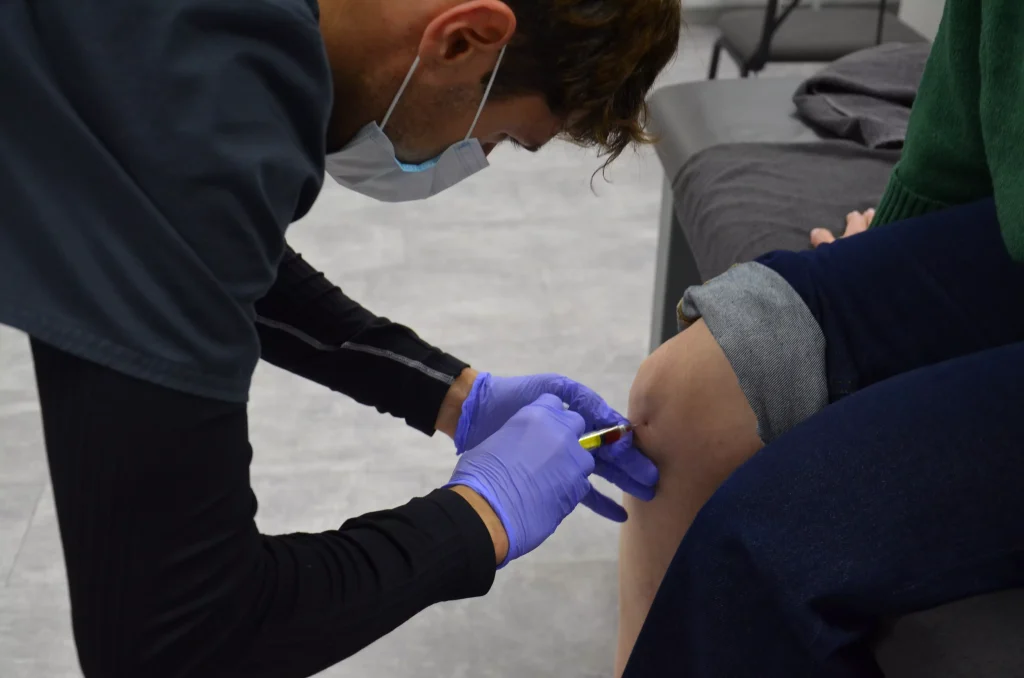
Plasma injected pointwise into the affected area - tendon, ligament, muscle, joint or fascia.
📌 Duration of the procedure: 15–20 min
📌 No hospitalization and no recovery period
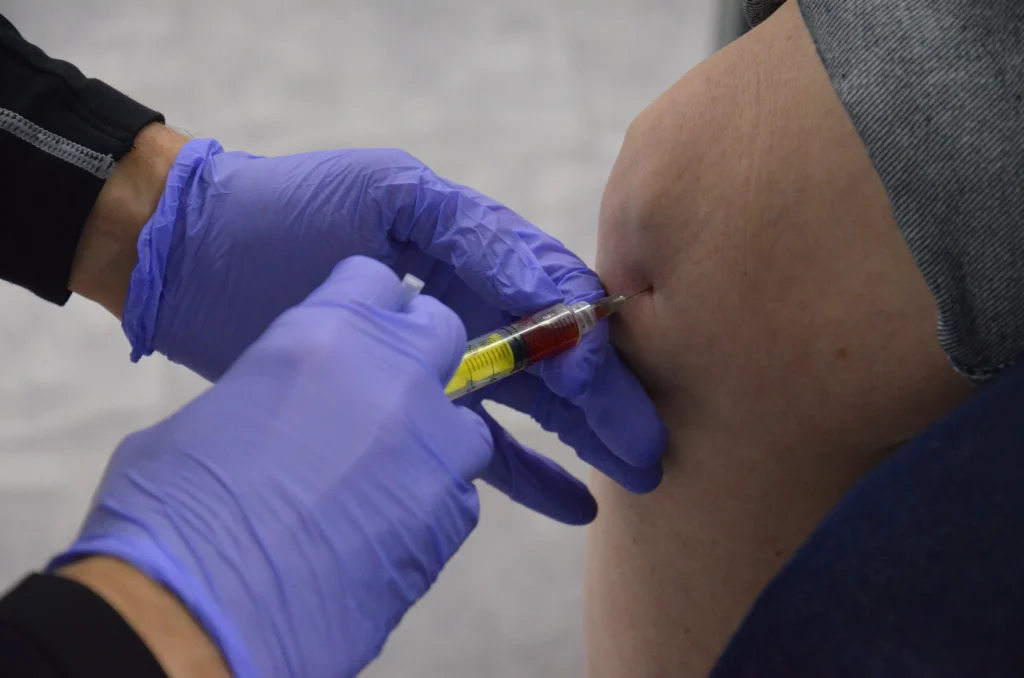
shoulder pain, "frozen shoulder"«
arthrosis of joints: knee, hip, shoulder
tendinitis and tendinopathies (shoulder, knee, Achilles tendon)
epicondylitis ("tennis elbow" / "golfer's elbow")
sprains and microtraumas of ligaments
heel spur / plantar fasciitis
chronic muscle strain in athletes
recovery after surgeries on joints and ligaments
Particularly effective, if:
the pain lasts longer 4–6 weeks

Leave your contacts — our specialist will contact you within 10–15 minutes to help you choose a service and answer all your questions.
PRP therapy and plasma therapy at KINEZIUM is an injection procedure using plasma obtained from the patient's own blood. After blood is drawn, it is processed to obtain plasma with an increased concentration of platelets, and then injected into the area according to indications. In a rehabilitation program, PRP can be considered as an auxiliary method for certain joint or soft tissue conditions, but not as a universal treatment. Before the procedure, an examination, assessment of the diagnosis, contraindications, medications and realistic expectations are mandatory. The result depends on the condition of the tissues, diagnosis, technique, course and combination with rehabilitation.
PRP joint therapy may be considered for patients with joint pain, overuse injuries, some forms of osteoarthritis, or knee problems after consulting a doctor. It is not suitable for everyone and should not be prescribed solely for the complaint of “knee pain.” It is important to assess the cause of the pain, the stage of changes, the presence of inflammation, trauma, infection, systemic diseases, and the expected benefit.
Situation | When PRP may be considered |
Knee pain | After examination, clarification of the cause of pain and exclusion of contraindications |
Mild or moderate osteoarthritis | As indicated, as part of a broader management plan |
Overuse of tendons or soft tissues | If the doctor deems the injection technique appropriate |
Return to activity | Only in conjunction with load control and rehabilitation |
Chronic discomfort | If conservative methods are evaluated and another step is needed |
After consultation | When the diagnosis, risks, course and expected effect are understood |
Plasma therapy for joints can be used to support tissue repair, address inflammation, and reduce pain as part of a comprehensive program. In the case of joints, it is often considered in the context of osteoarthritis or chronic pain, but the effects are not guaranteed and are not the same for everyone. PRP is not a substitute for exercise therapy, weight management, exercise dosage, physical therapy, or treatment of the underlying cause of the pain. If a joint is unstable, swollen, hot, or painful after an injury, a separate medical evaluation is required. The most appropriate expectation is a gradual possible effect, rather than rapid pain relief after a single procedure.
PRP therapy at the KINEZIUM center in Kyiv begins with a consultation, assessment of indications, contraindications, medications, allergies, concomitant diseases and expected results. Next, blood is drawn, plasma is prepared and injected into the designated area according to medical indications. After the procedure, the patient receives recommendations regarding the load, possible reactions, repeat visits and combination with rehabilitation. In the first days, local discomfort or tissue reaction is possible, so it is important to follow the recommendations of a specialist. If severe pain, fever, redness or a sharp deterioration in the condition occurs, you should consult a doctor.
PRP therapy differs from other injection techniques in that it uses the patient's own plasma, rather than a ready-made preparation with an external active component. Its goal is to support biological processes in the tissues, while other injections may be aimed at reducing pain, inflammation, or improving joint mobility more quickly. The choice of technique depends on the diagnosis, stage of the condition, symptoms, and medical limitations.
Criterion | PRP therapy | Other injection techniques |
Material | Plasma obtained from the patient's blood | Drug or other substance as indicated |
Expected pace | More often a gradual effect | May be faster or shorter depending on the drug |
Indication | Certain joint and tissue conditions after assessment | Depends on the type of injection and diagnosis |
Course | May require a series of treatments | Can be one-time or course |
Role in rehabilitation | An auxiliary method that does not replace exercise and load control | It should also fit into the overall treatment plan. |
Before plasma therapy, it is necessary to consider acute infections, blood clotting disorders, active inflammation in the area of the procedure, oncological risks, pregnancy, anemia or other blood disorders, taking anticoagulants or certain anti-inflammatory drugs, skin infections and uncontrolled chronic conditions. It is also important to inform the doctor about all medications, allergies, previous injections and reactions to the procedures. If the joint is hot, severely swollen, red or has a temperature, the injection procedure should not be performed without medical evaluation.
MedlinePlus describes synovial fluid analysis as a test that may be needed for joint pain with fever, swelling, redness, warmth, and difficulty bending the joint: https://medlineplus.gov/lab-tests/synovial-fluid-analysis/. AAOS OrthoInfo explains that the decision regarding injection techniques for orthopedic conditions should depend on the diagnosis, symptoms, and risks: https://orthoinfo.aaos.org/. A PubMed Central review of PRP for knee osteoarthritis highlights that results depend on protocol, patient characteristics, and study heterogeneity: https://pmc.ncbi.nlm.nih.gov/articles/PMC12156035/. Therefore, plasma therapy requires medical selection, not automatic prescription.
After PRP therapy in KINEZIUM, you can expect a gradual possible effect, which depends on the diagnosis, tissue condition, injection area, number of procedures, body reaction and combination with rehabilitation. Some patients may experience reduced pain and improved function, but the result is not guaranteed and is not the same for everyone. It is especially important not to return abruptly to overloads after the procedure, but to adhere to the movement plan, exercise therapy and activity control.
A PubMed Central review of PRP in knee osteoarthritis describes the potential of PRP to improve pain and function, but also notes the problems of protocol heterogeneity and varying quality of evidence: https://pmc.ncbi.nlm.nih.gov/articles/PMC12156035/. PubMed Central systematic reviews and meta-analyses on PRP in knee osteoarthritis report possible clinical improvements, but the effect depends on the patient group and technique: https://pmc.ncbi.nlm.nih.gov/articles/PMC11874499/. NIH/NCBI materials on regenerative and injectable approaches generally emphasize the need for proper patient selection and careful interpretation of results: https://www.ncbi.nlm.nih.gov/. Practical conclusion: PRP should be considered as part of a plan, not as a separate guarantee of joint recovery.
The price of PRP therapy in Kyiv depends on the area, number of injections, complexity of the condition, number of procedures in the course, preliminary consultation and need for additional diagnostics. For example, plasma therapy of the knee joint and a procedure for another area may have a different amount of preparation and execution. To register with KINEZIUM, you need to report your complaint, diagnosis, previous examinations, medications, allergies and concomitant diseases. Before the procedure, the doctor will assess the indications and contraindications, explain expectations and determine whether a combination with exercise therapy, physiotherapy or other recovery is necessary. This allows you to calculate the cost not “by name”, but according to the real treatment plan.
Leave your contacts — our specialist will contact you within 10–15 minutes to help you choose a service and answer all your questions.