 Skip to content
 Wellness centers
Patients were helped
Specialists
Years of experience
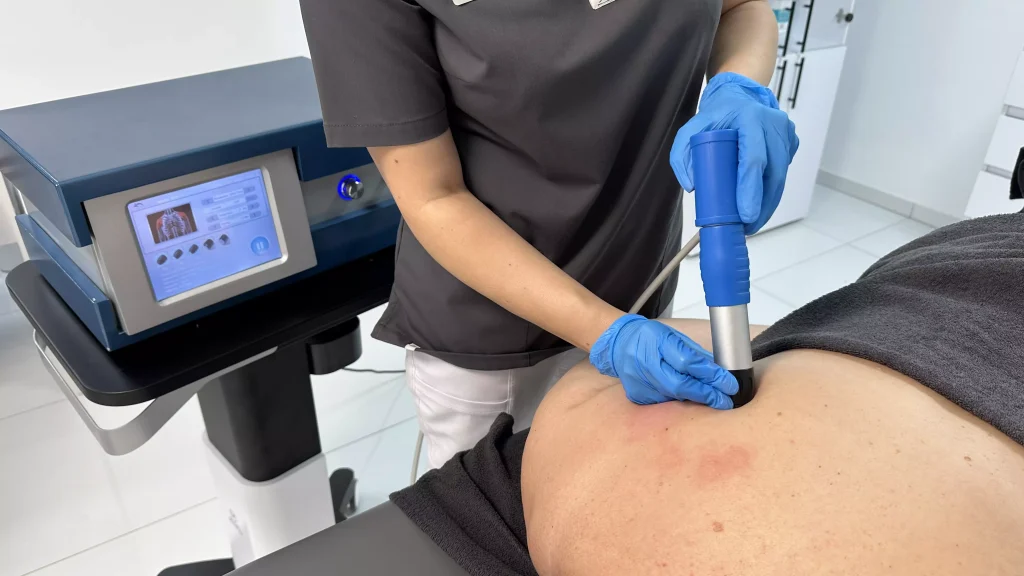
Shockwave radial therapy is a modern physiotherapeutic method that uses acoustic waves for deep impact on muscles and connective tissues. The wave penetrates the pain zone, relaxes overstrained muscles, improves blood circulation, accelerates cell regeneration and activates the body's natural recovery mechanisms.
Method does not require surgery, injections or medications — treatment occurs without trauma and without a rehabilitation period.
Pain reduction after 1–2 treatments
Restoring mobility of muscles and joints
Improving microcirculation and tissue nutrition
Stimulation of collagen synthesis and natural regeneration
No need for anesthesia or surgery
Can be combined with exercise therapy, massage, TECAR therapy, physiotherapy and other techniques
The method affects for the cause of pain, and not just eliminates the symptoms
Result accumulates with each session
Effective for chronic and "old" injuries, even when other methods have failed
Has a broad evidence base in orthopedics, sports medicine and rehabilitation
Radial shock wave therapy is recommended for:
heel spur (plantar fasciitis)
Achilles tendonitis
epicondylitis ("tennis/golfer's elbow")
shoulder pain, impingement syndrome
arthrosis, patellar syndrome
painful effects after sports
tension, spasms, trigger points
chronic myofascial pain
sprains, bruises, torn ligaments
post-traumatic scarring, contractures
We are grateful to everyone who has entrusted their health to us.
Your feedback is the best confirmation of the results of our work.
Share your impressions - they inspire us to become even better every day.
Leave your contacts — our specialist will contact you within 10–15 minutes to help you choose a service and answer all your questions.
We are always open for communication and ready to help you.
Call or email us to schedule a consultation or get detailed information.
Our experts will suggest the best solution for you.
Shockwave therapy, or SWT, at KINEZIUM is a physiotherapy method using acoustic waves to work with pain, tendons, fascia, muscle-fascial zones and joint areas after assessing the condition. The technique can be considered for chronic overload conditions, local pain in tendons or fascia, pain in the heel, elbow, shoulder, knee or other areas according to indications. Before the procedure, it is important to determine whether the source of pain is truly suitable for SWT, whether there is an acute injury, infection, thrombosis, blood clotting disorder or other contraindications. SWT is not a universal procedure “for any pain”, so it must be included in an individual plan. Most often, it has a supporting role together with exercise therapy, load control, work with movement technique and a gradual return to activity.
UHT therapy for joints may be necessary for pain in joints, tendons, heels, fascia, musculo-fascial areas and conditions after overloads. Often the procedure is considered for long-term local pain that is repeated during movement or load. However, if the pain is acute, appeared after an injury, accompanied by severe swelling, redness or temperature, a medical evaluation is required first.
State or area | When UHT may be considered |
Heel pain | For chronic pain in the plantar fascia area after assessment of the condition |
Tendon pain | For overuse tendon conditions without acute rupture |
Shoulder pain | If there are local tendon or periarticular complaints according to indications |
Knee pain | When the pain is related to soft tissue or overuse rather than an acute injury |
Elbow pain | For chronic local pain after exertion, if there are no contraindications |
Musculoskeletal zones | To work with local painful areas within the rehabilitation plan |
Shockwave therapy can play a supporting role in reducing pain, stimulating tissue repair processes, and improving function in comprehensive rehabilitation. It is often used not in the acute period, but in conditions where tissues respond to stress with pain for a long time. The procedure can help reduce the sensitivity of the painful area, but for a stable result, it is important to work with the cause of the overload: strength, mobility, technique, footwear, training regimen, or household loads. If the patient immediately returns to the provoking load after SCT, symptoms may recur. Therefore, SCT is better considered as part of a plan, not as the only treatment method.
During the SCT procedure, joints, tendons, fascia, heel, shoulder, knee, elbow and local painful areas can be treated according to indications. The area of impact is determined after examination, palpation, analysis of movements, load and preliminary examinations. Shock wave therapy is not performed on areas of active infection, thrombosis, tumor process, open wounds or areas where there is a high risk of bleeding. Caution is also required near nerve and vascular structures. If the pain is neurological in nature or there is suspicion of acute trauma, a different diagnostic route is first required.
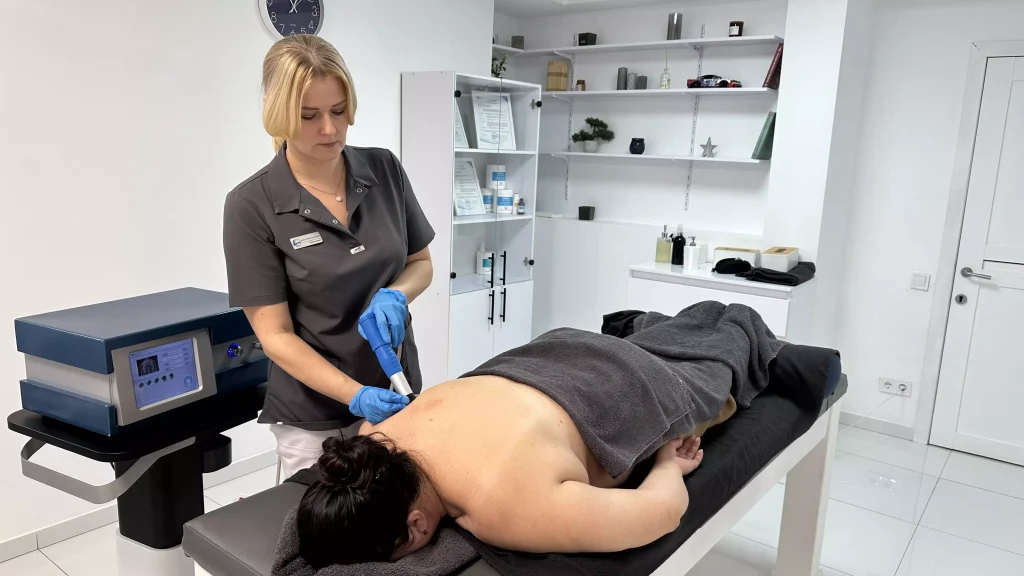
Shockwave therapy at the KINEZIUM center in Kyiv begins with a consultation, zone selection, clarification of complaints, contraindications and the entire procedure. A contact gel is applied to the skin, after which the specialist adjusts the intensity, frequency and number of pulses. During the procedure, the patient may feel a pronounced but controlled point effect; sharp unbearable pain is not the goal of the session. After SCT, there may be temporary sensitivity, redness or local discomfort, so the specialist gives recommendations on the load after the procedure. The course and frequency of sessions are determined individually according to the reaction of the tissues.
UHT differs from other physiotherapy methods in its acoustic effect and more focused work on tendon, fascial or local painful areas. Laser therapy uses light energy, electrotherapy uses currents, magnetotherapy uses a magnetic field, and UHT uses a mechanical acoustic wave. Because of this, the sensations during the procedure, indications and limitations differ.
Criterion | UHT | Laser therapy | Electrotherapy | Magnetotherapy |
Type of impact | Acoustic shock wave | Light energy | Electric currents | Magnetic field |
Feeling | Often intense, pinpoint, controlled | Minimal or light heat | Tingling, pulsation | Usually faintly noticeable |
Main tasks | Tendons, fascia, local painful areas | Auxiliary work with fabrics | Pain, spasm, neuromuscular reaction | Auxiliary tissue support |
Course | Usually several procedures with reaction monitoring | Individually selected | Individually selected | Individually selected |
Limitation | Blood clotting, thrombosis, pregnancy, infections, growth zones | Eyes, photosensitivity, skin, cancer risks | Pacemaker, skin, sensitivity | Pacemaker, pregnancy, cancer risks |
After a course of UHT in KINEZIUM, you can expect a gradual reduction in pain, better load tolerance and maintenance of function, if the technique is selected according to the indications. The effect depends on the diagnosis, the duration of the problem, the number of procedures, intensity, tissue reaction and combination with rehabilitation. In chronic tendon or fascial conditions, the result is often assessed not immediately after the first session, but in the dynamics of the course and the return of the load. If the cause of the overload is not changed, the pain may return.
AAOS OrthoInfo describes ESWT for plantar fasciitis as a noninvasive procedure that is sometimes considered before surgery, but also notes that results have not always been consistent: https://orthoinfo.aaos.org/en/diseases–conditions/plantar-fasciitis-and-bone-spurs. NICE has guidelines on shockwave therapy for refractory plantar fasciitis and emphasises that decisions should be made based on evidence and clinical context: https://www.nice.org.uk/guidance/htg200. A PubMed Central review of ESWT for musculoskeletal pain describes the method as generally safe and potentially beneficial, but effectiveness depends on the condition and protocol: https://pmc.ncbi.nlm.nih.gov/articles/PMC10648068/. Practical conclusion: UHT can be a useful part of recovery, but it does not guarantee the same result for everyone.
The price of shock wave therapy in Kyiv depends on the area of impact, number of procedures, complexity of the condition, intensity, type of device and course format. Work with one local area and a comprehensive program for several areas may have different costs. To enroll in KINEZIUM, you need to describe the localization of pain, duration of symptoms, previous examinations, injuries, medications, blood clotting problems or vascular risks. After the assessment, the specialist will explain whether SCT is suitable, how many procedures may be required and what loads to limit between sessions. This allows you to calculate the course not formally, but for a specific clinical task.
Leave your contacts — our specialist will contact you within 10–15 minutes to help you choose a service and answer all your questions.
Leave your contacts - our specialist will contact you within 10-15 minutes to help with the service and answer all your questions.